
A leak test result is only useful when you know what physical principle produced it, which defects it can detect and whether the pack survives the test. By the end, you will be able to define a test method, operating window, acceptance limit and supplier evidence instead of choosing equipment from a catalogue name alone.
Key takeaways
- Match gross holes, seal channels and molecular leaks to different detection principles.
- Document the test pressure, vacuum, dwell time and pack-conditioning procedure.
- Confirm seal materials, pack geometry and closure design before accepting a quoted range.
- Set pass-fail limits from product risk, not the instrument display resolution.
Choose the leak-detection principle before choosing the apparatus
A gross hole, a seal channel and a molecular-scale leak require different evidence. Choose the defect and package first, then choose a leak test apparatus.
| Method | Principle | Best fit |
|---|---|---|
| Vacuum or pressure decay | Measures pressure change after isolation | Non-destructive screening; package-specific development is needed for flexible walls, small headspace, outgassing and temperature drift |
| Tracer-gas detection | Measures escaped helium or another tracer gas | Fine-leak detection when sensitivity and quantified leak rates matter |
| High-voltage leak detection | Detects electrical discharge through a breach | Pinholes in suitable nonconductive packs with a conductive product or backing |
| Dye or microbial ingress | Looks for liquid dye or microorganisms entering a defect | Destructive challenge tests; results are probabilistic, not direct leak-rate measurements |
A desiccator-based vacuum test commonly screens gross leaks through pressure change, bubble formation or liquid movement. Confirm the exact operating principle, sensitivity and package limitations with the supplier. USP <1207> favours scientifically controllable deterministic methods for validated container-closure-integrity work, but requires demonstration on the actual pack and defect type.
ASTM F2096 bubble emission pressurises a pack under water and reveals gross leaks; it is destructive. ASTM F1929 uses dye penetration to find channel leaks in porous seals and is also destructive. ASTM F88 measures seal-separation force, not leakage: a strong seal can still contain a channel leak.
Use a vacuum-decay or pressure-decay leak testing machine for pharmaceutical packs only after method development establishes conditioning, stabilization, hold time and limits for the specific geometry. Never confuse gross-leak screening with fine-leak detection.
Define the operating procedure and the test’s effect on the pack
Record the method-specific operating window before testing: vacuum or pressure range, stabilization time, measurement time, total cycle time, chamber capacity, usable pack length, width and height, and samples per cycle. A leak test apparatus must also identify the pack, batch, orientation and recipe.
- Verify pack identity, batch number, seal condition and orientation against the work instruction.
- Load the stated number of samples without nesting or contact that changes wall movement. Check usable dimensions and chamber capacity.
- Seat the pack against the specified gasket or fixture. A displaced gasket creates a chamber leak that looks like a pack leak.
- Close and latch the chamber, then confirm the seal before applying vacuum or pressure.
- Condition the pack and chamber for the documented temperature and stabilization time.
- Apply the specified vacuum or pressure, allow stabilization, then hold for the written measurement time.
- Record pressure or vacuum change, measured leak response, alarms and visible movement. Note flexible-wall movement, outgassing, elastomer relaxation and temperature drift; extending dwell time alone cannot separate these effects from a true leak.
- Release the chamber through its controlled, safe vent or equalisation step, remove the sample and segregate it from production stock.
Vacuum-decay and pressure-decay tests can be non-destructive when the pack remains intact. Liquid immersion, dye ingress, puncturing or visible seal manipulation makes that sample unsuitable for release. Return tested packs only after the method’s documented non-destructive status and release rule permit it.
Check pack construction before accepting a quoted test range
A quoted test range is credible only after the machine has tested your production pack. Check blister lidding foil, PVC or PVDC forming film, aluminium strip laminate, sachet film and pouch laminate, then record seal width, seal temperature, headspace, product fill, orientation and nesting.
Flexible walls move under vacuum or pressure; small headspace produces a smaller measurable response. Irregular contents shift that response, while weak chamber seals create false leaks and different laminate stiffness changes deflection. Put pack length, width, thickness, cavity height, seal perimeter and maximum loaded weight in the specification.
- Ask the pharmaceutical machines manufacturer to demonstrate the method using production-equivalent good packs and deliberately defective packs, not an empty reference fixture.
- Watch loading, gasket contact, chamber closure, stabilization, measurement, hold time and controlled atmospheric release. Record the vacuum or pressure range, chamber capacity, usable dimensions and samples tested per cycle.
- Compare dye ingress or bubble emission for destructive gross or channel-leak investigation; use vacuum decay or pressure decay when package-specific non-destructive measurement is proven. Use high-voltage detection for conductive-path defects in suitable films, and microbiological challenge testing when microbial-barrier performance requires biological evidence.
Sterile products need a broader container-closure-integrity strategy, not an end-of-line machine decision alone. ISO 11607 is an engineering reference for validated integrity and maintenance of sterility in terminally sterilized medical-device packaging; complete a separate pharmaceutical compliance review before applying it.
Set acceptance criteria from product risk, not from the display resolution
A pack passes only when its observed result stays within a scientifically justified limit set by Quality, packaging engineering and microbiology or sterility assurance—not by the display resolution of a leak testing machine for pharmaceutical packs.
Visible bubbles, dye ingress, loss of vacuum, pressure decay and a calculated leak rate are different observations; each needs its own acceptance criterion.
Set the limit against product risk, microbial-barrier requirements, package design, critical defect size and method capability. No universal leak number can be copied from a brochure.
- Define the reference: use reference standards, calibrated leaks or known-volume verification, controlled temperature and humidity, and a documented conditioning and stabilization period.
- Qualify the method with production-equivalent good packs and representative defective packs. Record repeatability, reproducibility, false rejects, false accepts, alarm response and reject segregation.
- Record the decision rule for each method: bubbles or dye crossing a specified channel, vacuum loss beyond a defined value, pressure decay beyond a defined rate, or measured leakage above the validated limit.
- Review deviations and trends through the approved container-closure-integrity strategy for sterile products. Assign ownership for changes to film, foil, seal temperature, tooling and software recipes.
Do not substitute ASTM F88 seal-strength data for leak data. ASTM F88 reveals seal-process variation, but a strong seal can still contain a channel leak, while a lower force does not automatically prove leakage.
A pharmaceutical machines manufacturer should show this evidence before you approve the limit. The test record must also identify the method, pack, conditioning, stabilization time and calibrated verification result.
Turn a Thane supplier search into a documented equipment specification
Before placing an order, ask a pharmaceutical machines manufacturer in Thane for leak test apparatus to define a validated operating window, not just maximum throughput. Require written limits for:
- Pack materials, length, width, thickness, seal perimeter and loaded weight
- Minimum demonstrated defect or leak rate, vacuum or pressure level, stabilization time and measurement time
- Changeover duration, chamber capacity, samples per cycle, environmental range and utilities
- Orientation, nesting, chamber loading, seal compression, conveyor indexing and reject segregation
Poor handling can imitate a sensor failure: a tilted pack may seal badly, nested packs may block the chamber, and a missed index may send a good pack to reject.
| Evidence requested | What to verify | Why it matters |
|---|---|---|
| Operating data | Good-pack and deliberate-defect challenge results | Proves package-specific sensitivity |
| Instrumentation | Calibration records, calibrated leaks or known-volume checks | Display resolution is not leak capability |
| Construction | Product-contact material certificates; hygienic, cleanable surfaces | Supports contamination control |
| Controls | Controlled recipes, permissions and audit trails where applicable | Prevents unapproved setting changes |
| Qualification | FAT, SAT and IQ/OQ-ready protocols | Defines commissioning evidence |
Ask a pharma machinery manufacturer in Thane how temperature drift, outgassing, elastomer relaxation and flexible-wall movement are controlled; extending dwell time alone does not solve them. Require safe chamber release and documented segregation of tested packs from production stock.
Jicon Technologies Pvt Ltd should be evaluated against this checklist, because Thane improves service access but does not establish GMP suitability. Compare package-specific data, commissioning support and change-control response before model names or nominal chamber size.
Related products
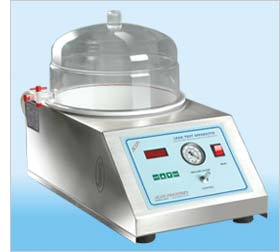 | Accessories and Ancillary Equipments Leak Test Apparatus (LTA-150/ 300) ₹1 LTA -150 and LTA - 300 are Leak Test apparatus models by Jicon Technologies. 150 and 300 denotes the diameter of the desiccator. View product → |
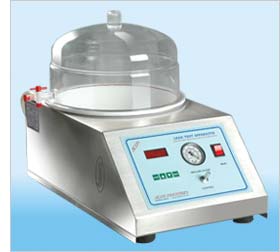 | Accessories & Ancillary Equipments Leak Test Apparatus for Pharmaceutical Blister packs and others LTA -150 and LTA - 300 are Leak Test apparatus models by Jicon Technologies. 150 and 300 denotes the diameter of the dessicator. |
Frequently asked questions
How do you choose a leak-detection principle for pharmaceutical packs?
Identify the defect you need to detect first. Gross holes, seal channels and molecular-scale leaks require different evidence and detection methods.
What operating details belong in a leak-test procedure?
Specify the test pressure or vacuum, dwell time, pack orientation, conditioning, sampling plan and whether the test damages or alters the pack.
Why must pack construction be checked before accepting a quoted test range?
Film, foil, seals, blisters, bottles and closures respond differently to pressure and vacuum. Confirm the pack geometry, materials and closure design against the apparatus range.
How should you set leak-test acceptance criteria?
Base the pass-fail limit on product risk and the defect that threatens sterility, shelf life or dose protection. Do not use display resolution as the acceptance limit.
Related product
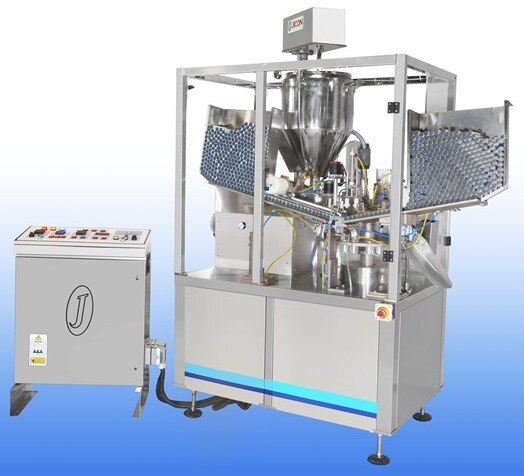 | Tube Filling Machines Automatic Tube Filling Machine ₹1 FILLTUBE Machines are designed to fill and seal plastic, laminated and aluminium tubes at high speeds. View product → |