
A blister can look perfectly sealed while a pinhole, seal channel, cracked forming web or leaking tester allows moisture and air to reach the product. By the end, you will be able to follow a vacuum-and-liquid leak test, separate pack failures from equipment faults, and judge whether a test method is validated for your blister format.
Key takeaways
- Test the seal perimeter, foil, cavities and pocket transitions for pressure paths.
- Record vacuum level, hold time, sample count and pass or fail criteria.
- Separate a true leak from poor sealing, trapped air or test setup errors.
- Require recipe control, calibration records and traceable test results before integration.
What a blister leak tester measures
A leak test measures whether a pressure path connects the blister interior to its surroundings. That path can pass through a pinhole in the lidding foil, the seal perimeter, a formed cavity or a transition between pockets.
An intact seal around one cavity does not exclude a crack in the forming web or a seal channel elsewhere.
Package-integrity testing is not seal-strength testing. ASTM F88 measures the force needed to separate a seal; it does not prove leak-tightness. Use it for process control or qualification alongside a leak test, not instead of one.
Before using the leak test apparatus, check:
- Confirm that the vacuum pump reaches the method’s required vacuum, the regulator adjusts smoothly, and the gauge returns to zero.
- Inspect the transparent desiccator for cracks, the cover seal for cuts or flattening, and the vacuum hose and fittings for leaks.
- Confirm that the fixture supports the pack without touching or covering the seal land, formed web, cavity, or pocket transition. Contact can mask a leak.
- Check that the fixture and chamber volume match the validated method.
ASTM F2096 bubble emission pressurizes a package and reveals gross leaks as bubbles in liquid; immersion can damage or alter a blister. ASTM F2338 vacuum decay instead measures pressure change as gas enters a chamber from the pack. It can be nondestructive, but chamber sealing, fixture volume, hold time and blister geometry determine sensitivity.
Test aluminium-aluminium and thermoformed plastic blisters under separately bridged methods.
How to run the vacuum-and-liquid test
1. Inspect the transparent desiccator for residue, scratches and trapped liquid, then clean and dry it. Check that the cover gasket sits evenly, the vacuum hose is secure, and the regulator, gauge and connections hold vacuum without audible leakage.
2. Place one unopened blister in the fixture. Support the card without covering the seal perimeter, formed web or transition between pockets; fixture contact can hide the very leak you need to find.
3. Add the specified compatible liquid to the required depth. Use a liquid that does not soften or swell PVC, attack aluminium foil, or damage cold-formed aluminium or its coating. Keep the liquid and sample at the method temperature.
4. Close the cover, apply vacuum through the regulator, and increase it gradually to the approved setpoint. Stabilize the gauge reading before starting the hold period; a falling reading during stabilization can indicate apparatus leakage rather than a defective blister.
5. Hold the vacuum for the defined time, then release it slowly through the vent. Opening the cover under vacuum can damage the pack and disturb the observation.
6. Inspect every cavity, seal channel and web. Continuous bubbles indicate an active pressure path; bubbles emerging from a seal channel locate a perimeter-seal defect. Liquid inside a cavity indicates ingress through the lidding foil, seal or forming web.
Foil lifting points to seal adhesion or peel failure, while a cracked forming web identifies damage in the plastic structure.
For a pharmaceutical machines manufacturer leak test apparatus for process investigations, use dye only for a disposable troubleshooting sample. Dye penetration, described by ASTM F3039, adds visual interpretation and liquid contact; it is not a routine nondestructive production test.
How to define vacuum, time and pass or fail
A pass/fail result is valid only when the complete method—not a brochure vacuum number—has been fixed and validated. Record the blister construction, product and liquid temperature, sample quantity, liquid depth, evacuation level, stabilization time, hold or measurement time, chamber and fixture volume, and maximum allowable leak or pressure-change limit.
Under ASTM F2338, the pressure-decay result is deterministic; bubble or dye observations depend on liquid, lighting and operator judgement.
Use a controlled method sheet that also defines:
- The exact fixture, sealing-land contact and pocket support; contamination, wear or a blocked seal can create false accepts or false rejects.
- Repeatability checks across operators, runs and samples.
- Characterized known-leak standards near the acceptance threshold, plus confirmed-good packs, during validation.
- The rule for an invalid test, such as unstable vacuum, damaged sample or failed equipment check.
A pharmaceutical machinery manufacturer must bridge the method separately for each pack construction. Aluminium-aluminium and thermoformed plastic differ in stiffness, cavity volume, foil or web permeability and collapse under vacuum, so one validated setting cannot transfer automatically.
| Construction | Method concern | Required control |
|---|---|---|
| Aluminium-aluminium | Rigid foil and cavity geometry alter chamber response | Re-establish decay limit and fixture seal |
| Thermoformed plastic | Web flexibility and forming stress can distort under vacuum | Confirm support, volume and known-leak response |
| Bubble or dye test | Observation changes with operator and liquid | Define lighting, viewing time and acceptance wording |
| Vacuum decay | Instrument records pressure change over time | Set a numerical limit and reject unstable runs |
How to choose samples and diagnose a failed result
Select unopened cards under a written sampling plan. Cover different lanes, edge cavities and corner seals, then include cards made at start-up, after a machine adjustment, and after each foil or forming-web roll changeover. Record lane, cavity position, time and material lot.
Before rejecting product, repeat the result with a confirmed-good pack and an intentionally known-leak standard. The good pack must pass and the known leak must fail; otherwise investigate the test system instead of the batch.
- Trapped surface air: wipe and reposition the card; surface bubbles that stop after removal are not proof of a leak.
- Damaged sample: inspect the foil, formed web and seal perimeter for cuts, cracks or handling marks, then test an undamaged card.
- Improperly closed cover: check full gasket contact and the cover latch; an uneven seal causes chamber leakage.
- Contaminated sealing land: remove powder, liquid or foil fragments from the fixture and pack seal area.
- Worn gasket: look for flattening, splits or permanent set and replace it.
- Leaking hose or desiccator: isolate connections and confirm that the chamber holds vacuum without a pack.
- Pack leak: bubbles continue from a seal channel, corner, cavity or web defect after the equipment passes its checks.
| Result | What it supports | What it does not prove |
|---|---|---|
| One sampled card passes | That card passed the defined method | Every card in the batch is leak-free |
| Several locations pass | Evidence for the approved sampling plan | Unchecked lanes or changeover periods |
| Known-leak challenge fails | The test can detect that defect | Suitability for another blister format |
A pharma machinery manufacturer should document sampling, reject segregation and protection against rejected cards re-entering good product.
What to require when buying or integrating the equipment
A buyer’s specification should define the inspection route, product recipes, reject path and validation evidence—not just the detector’s nominal sensitivity.
1. Ask whether the station is an offline laboratory unit, a periodic-sample station or a 100% in-line inspection. Request the sampling plan, card quantity, lane coverage and response to a failed sample; sampled results do not prove every card is leak-free.
2. Require recipe controls for blister length, pocket pattern, cavity depth and lidding material. Each recipe should identify the nest, fixture seal, test-head position, vacuum method and validated acceptance limit, with password control preventing unauthorised changes.
3. Demand documented reject handling. A failed card needs physical separation, a recorded disposition and a transfer path that prevents it returning to the good-product stream. Check pocket registration, cavity support, sealing-land cleanliness, gasket wear and foil entrapment during integration.
4. Request qualification evidence using characterized known-leak challenges near the acceptance threshold and confirmed-good packs. Ask how the pharmaceutical machines manufacturer controls chamber volume, fixture sealing, evacuation, stabilization and measurement time for an ASTM F2338 vacuum-decay method; ASTM F88 seal strength is complementary, not a leak test.
ISO 11607 treats integrity as part of the complete packaging system. Qualification at the machine builder does not replace validation at your site through storage, distribution and sterilization where applicable.
If assessing Jicon Technologies Pvt Ltd, ask specifically how its nests, changeover controls, known-leak challenges and validated limits match each blister format rather than accepting a model specification as proof of suitability.
Related product
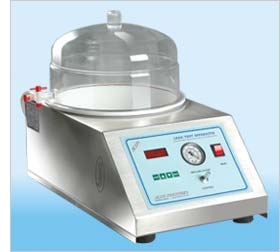 | Accessories & Ancillary Equipments Leak Test Apparatus for Pharmaceutical Blister packs and others LTA -150 and LTA - 300 are Leak Test apparatus models by Jicon Technologies. 150 and 300 denotes the diameter of the dessicator. |
Frequently asked questions
What does a blister leak tester measure?
It measures whether a pressure path connects the blister interior to its surroundings through the foil, seal perimeter, cavity or pocket transition.
How do you run a vacuum-and-liquid blister leak test?
Place the selected blisters in liquid, apply a defined vacuum for a defined hold time, and inspect for bubbles or another specified failure signal.
How should you define vacuum, test time and pass or fail?
Set them in a documented, validated method that reflects the pack design, product risk and test sensitivity, then apply the same criteria to every sample.
How do you choose samples and diagnose a failed result?
Use representative packs from relevant batches and positions, isolate the failed pack, inspect the seal and foil, and repeat the test with controlled setup conditions.
What should you require when buying or integrating leak test equipment?
Require controlled recipes, calibrated vacuum measurement, defined test timing, clear pass or fail outputs, data records and compatibility with your line and pack format.