
Choosing an ointment line starts with the formulation, not the machine catalogue. You will be able to map each processing step, specify the vessel and filling system, calculate capacity and utilities, and compare an Ahmedabad supplier with outside manufacturers on evidence rather than location alone.
Key takeaways
- Classify the product before selecting a heated mixer, emulsion system or aseptic line.
- Match agitator and homogeniser design to viscosity, particle size and emulsion requirements.
- Size the batch, transfer and filling stages as one connected production system.
- Ask Ahmedabad suppliers for drawings, qualification documents, testing records and utility requirements.
Map the ointment process before choosing equipment
A pharmaceutical machinery manufacturer assessing ointment manufacturing for a plant in Ahmedabad must first classify the product as anhydrous ointment, aqueous cream, paste, gel or sterile ophthalmic ointment. That decision determines whether you need an emulsion train, a simple heated mixing vessel, or a separate aseptic design.
Do not specify ISO 5 conditions for an ordinary non-sterile topical product, or treat an ophthalmic line as a standard ointment room.
Map the process in this order:
- Dispense and charge powders, oils, waxes and water separately; prepare oil and aqueous phases when the formula is an emulsion.
- Heat each phase to its validated temperature, combine them under controlled agitation, then homogenise if droplet size or texture requires it.
- Apply vacuum at the validated mixing stage to remove entrained air, cool the bulk, and transfer it through a hygienic bottom outlet.
- Hold for the defined maximum time, then fill; aqueous products also require purified-water controls, system sanitisation, equipment drying and time limits between manufacture and filling.
| Product route | Required configuration | Avoid this mistake |
|---|---|---|
| Anhydrous ointment or paste | Heated vessel with anchor, planetary or high-shear mixing; no emulsion plant unless the formula needs it | Buying phase tanks that add cleaning and transfer steps |
| Aqueous cream or gel | Oil and water phase vessels, emulsification or homogenisation, vacuum, cooling and controlled holding | Assuming mixer volume controls microbial risk |
| Sterile ophthalmic ointment | Dedicated sterilisation or aseptic-processing strategy, sterile filtration where suitable, controlled environment and validated filling | Using a non-sterile topical line |
Require drawings, material certificates, welding and finish records, calibration data, FAT and SAT protocols, and IQ/OQ support before purchase. Running during a demonstration is not qualification.
Match the agitator and homogeniser to the formulation
An anhydrous wax/oil ointment usually needs a jacketed vessel with an anchor or sweep agitator, not a complete emulsion plant. Add scraper blades when the batch is viscous enough to build on the vessel wall.
| Formulation | Main mixing technology | Add homogenisation or milling when |
|---|---|---|
| Anhydrous ointment | Heated anchor or sweep agitator with scrapers | Wax must dissolve faster, or solids need dispersion |
| Cream or aqueous ointment | Anchor agitator for bulk movement, plus rotor-stator homogeniser | Oil and water phases must form a stable emulsion |
| Paste | Planetary mixer or high-torque anchor | Powders need intensive wetting or agglomerate control |
| Gel | Anchor agitator with controlled shear | Polymer hydration, lump removal or particle-size reduction requires it |
A rotor-stator homogeniser reduces droplets or disperses particles; it does not replace the anchor’s wall-to-centre circulation. An inline homogeniser suits recirculation and continuous passes, while a colloid mill suits certain high-shear dispersions but can add heat and restrict particle-size control.
Specify mixing speed, homogenisation time, temperature profile, vacuum point and order of addition in the validation protocol. Link them to viscosity, assay uniformity, emulsion stability, particle or droplet size and microbial quality.
Vacuum removes entrained air only when the vessel, condenser or receiver, leak rate and application point support effective deaeration. Size the transfer pump and filler against the product’s temperature, viscosity, thixotropy and stringing behaviour; a quoted litres-per-hour figure alone is not enough for an ointment manufacturing plant.
Specify hygienic vessels, vacuum and plant utilities
Put working batch volume, not gross capacity, on the specification. State 316L product-contact steel, internal surface finish, jacket or half-pipe heating and cooling duty, agitator torque, homogeniser tip speed, bottom outlet, load cells, sight glass and sampling valve.
Define vacuum level, leak rate, condenser or receiver, and when vacuum is applied; a pump alone does not prove deaeration.
Require a pharmaceutical machinery manufacturer to provide these purchase deliverables:
- Approved user-requirements specification and equipment drawings
- Material certificates, weld records and surface-finish records
- Calibration records for temperature, pressure, load cells and vacuum instruments
- Factory-acceptance-test and site-acceptance-test protocols
- Installation- and operation-qualification support
- A process-validation package linking mixing speed, temperature, vacuum and hold time to viscosity, uniformity, stability, microbial quality and fill weight
Compare suppliers on the same technical basis:
| Area | Weak basis | Decision-grade specification |
|---|---|---|
| Mechanical | “1,000-litre vessel” | Working volume, agitator torque, transfer-line diameter, pump type and performance at actual product temperature and viscosity |
| Hygienic | Polished tank only | Drainable geometry, validated cleaning coverage, spray ball, sanitary sampling valve, smooth welds and traceable 316L certificates |
| Vacuum | Vacuum pump included | Operating range, allowable leak rate, receiver or condenser arrangement and validated deaeration point |
| Utilities | Utility connections available | Heating medium and duty, chilled-water flow and temperature, compressed-air quality and pressure, electrical load, vacuum demand and drain capacity |
Calculate capacity from batch size through filling
Size the line from the validated working batch, not the vessel’s gross volume. Convert the target mass to volume using formulation density, then reserve headspace for agitation, vacuum and foam; a 100 kg cream at 1.1 kg/L occupies about 91 L before allowance for process losses.
- Manufacturing vessel: set minimum and maximum working levels, including oil and aqueous phase volumes, wall hold-up and transfer losses. Confirm anchor torque at the coldest, most viscous stage, not only at the final temperature.
- Holding vessel: provide capacity for the transferred batch plus line drainage and the defined filling window. For aqueous creams, specify the maximum bulk hold time, temperature band, purified-water controls and equipment-drying requirement; a large tank does not control microbial risk.
- Transfer system: size the pump and line for actual viscosity, yield stress, temperature, thixotropy and air sensitivity. Check pressure at the farthest filler, dead legs, drainability and residence time rather than accepting a litres-per-hour claim.
- Filler: run piston, servo-piston, time-pressure or auger trials at the real product temperature and after the planned hold. Record fill-weight variation, stringing, retained air, nozzle recovery and changeover time.
- Utilities: calculate peak simultaneous heating, cooling, vacuum, compressed-air and electrical demand. Heating duty follows mass, specific heat, temperature rise and cycle time; cooling duty must also remove mixer and homogeniser heat.
Give every figure to an ointment manufacturing plant manufacturer in Ahmedabad on the same basis: working volume, duty, torque, line diameter, utility consumption and test results. Nominal strokes per minute prove nothing about production output.
Compare Ahmedabad suppliers on qualification evidence
Do not select a supplier because a demonstration vessel runs. Before purchase, require evidence that the pharmaceutical machinery manufacturer can control design, fabrication, installation and validation.
- An approved user-requirements specification, general arrangement and piping-and-instrumentation drawings
- Material certificates for product-contact steel, calibration records, and welding and surface-finish records
- Factory-acceptance-test and site-acceptance-test protocols with pass criteria and signed results
- Installation Qualification and Operational Qualification protocols, execution support and deviation handling
- A vacuum specification stating operating level, allowable leak rate, condenser or receiver arrangement and the validated point for applying vacuum
| Evidence | Acceptable proof | Red flag |
|---|---|---|
| URS compliance | Signed requirement-to-drawing traceability matrix | Supplier changes the specification after ordering |
| Capacity | Working batch volume, heating and cooling duty, agitator torque and homogeniser tip speed | Capacity quoted only as gross litres |
| Transfer and filling | Pump and filler tested at your product temperature, viscosity, thixotropy and stringing behaviour | Flow stated only in litres per hour |
| Cleaning and validation | Cleaning method, coverage evidence, sampling points and IQ/OQ deliverables | “GMP compliant” without test records |
Demand a process-validation matrix linking mixing speed, homogenisation time, temperature, vacuum, addition order and bulk hold time to assay uniformity, viscosity, emulsion stability, particle or droplet size, microbial quality and fill-weight uniformity. Jicon Technologies Pvt Ltd should be assessed against that same matrix, not proximity alone.
Do not specify an aseptic or ISO 5 plant for ordinary non-sterile topical ointments. Sterile ophthalmic products require a separate contamination-control, sterilisation or aseptic-processing strategy.
Related products
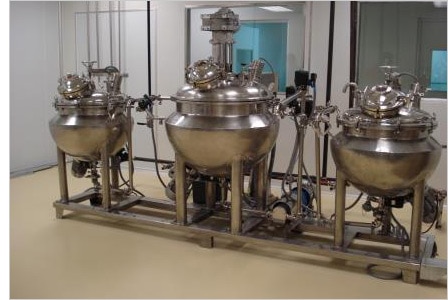 | Process Equipments Ointment Cream and Toothpaste Manufacturing Plant Automatic Ointment / Cream Manufacturing Plant is used to prepare medicated homogenised emulsion of Wax and Water to a particular formulation. View product → |
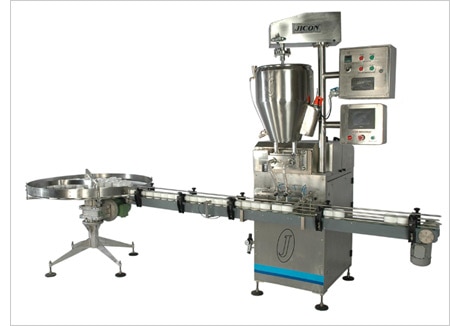 | Container Filling Machines Automatic Container Jar Filling Machine for Ointment and Others High speed automatic multi head container filling machine for filling cream, paste, ointment, wax polish, grease, jam, sauce etc. |
Frequently asked questions
How do you map the ointment process before choosing equipment?
Classify the product as anhydrous ointment, aqueous cream, paste, gel or sterile ophthalmic ointment, then map heating, mixing, homogenising, vacuum, transfer and filling steps.
How should you choose an agitator and homogeniser for ointment manufacturing?
Match the equipment to formulation viscosity, emulsion requirements, particle size and heat sensitivity. A simple heated mixer suits some anhydrous products, while creams need controlled dispersion and homogenisation.
What vessel, vacuum and utility details should an ointment plant specification include?
Specify hygienic stainless steel construction, vessel geometry, cleanable surfaces, heating and cooling, vacuum range, product transfer method, compressed air, electrical load and other plant utilities.
How do you calculate ointment plant capacity?
Calculate output from batch size, mixing and heating time, transfer time, filling speed, changeover, cleaning and planned production hours. The filling stage must handle the upstream batch schedule.
How can you compare ointment machinery manufacturers in Ahmedabad?
Request equipment drawings, process descriptions, material specifications, control-system details, factory acceptance testing records, installation support and qualification documents before comparing quotations.
Related products
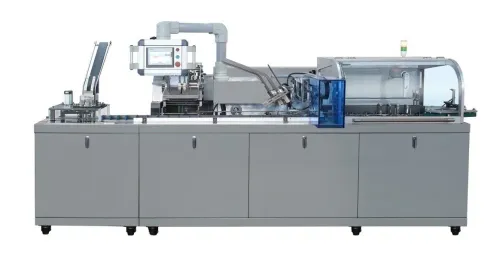
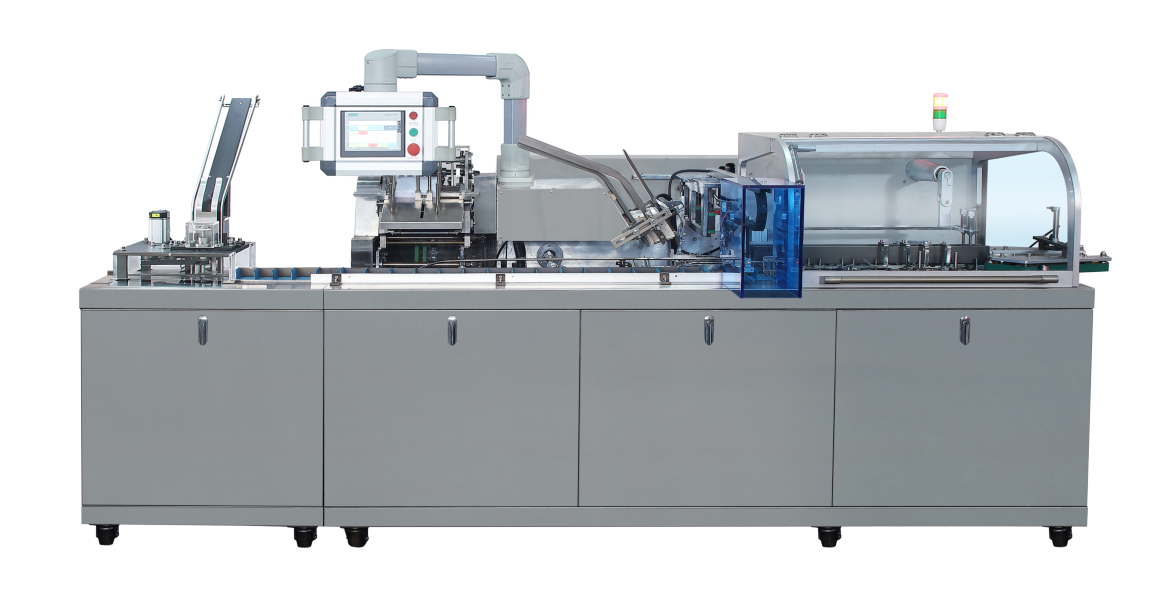 | Accessories & Ancillary Equipments Auto Cartonator for Blistered Strips and Tubes ₹1 JCT-100 and JCTBL -100 are truly powerful horizontal cartoning machines of intermittent motion. View product → |
 | Container Filling Machines Automatic Container Filling Machine High speed automatic multi head container filling machine for filling cream, paste, ointment, wax polish, grease, jam, sauce etc. View product → |