
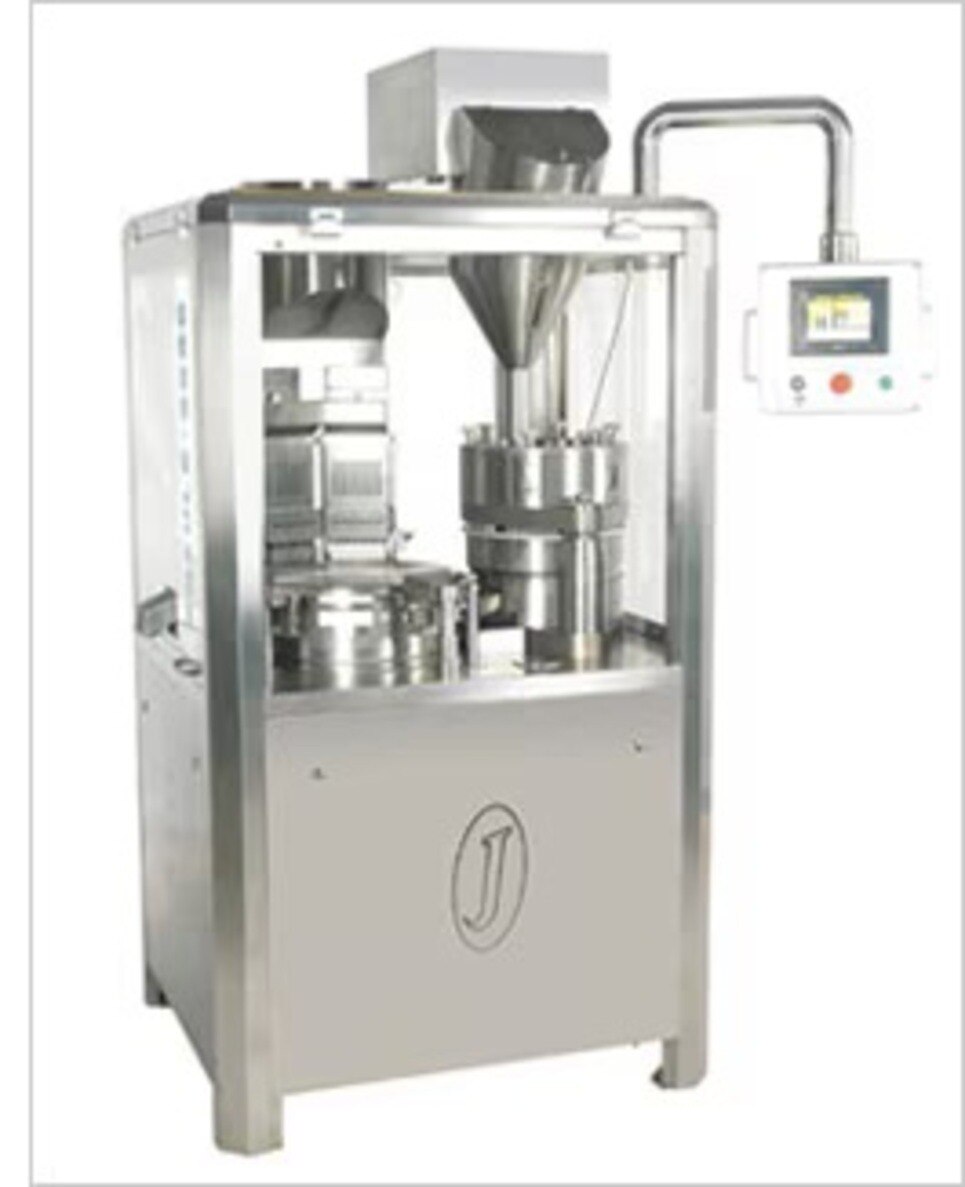
A Riyadh production peak is not solved by choosing the largest number on a machine nameplate. You need to convert the peak-week schedule into saleable capsules per hour, test the formulation on the dosing system, and verify that utilities, cleaning, validation and local support will sustain the planned output.
Key takeaways
- Divide required capsules by available hours, then account for OEE and shift capacity.
- Choose dosator, tamping-disk, or liquid dosing for the formulation’s flow and fill behaviour.
- Specify capsule sizes, changeover time, in-process checks, and batch documentation before comparing machines.
- Reject automation when peak demand is too short-lived to justify validation and changeover effort.
How much saleable capacity does the peak actually require?
Required saleable capsules per hour equals peak-week batch quantity divided by available production hours before the release deadline, adjusted for the number of shifts. For a capsule filling machine for peak demand, divide that result by OEE: availability × performance × quality.
Availability loses time to cleaning, format changes, powder replenishment and stoppages; performance loses speed to slow feeding and minor jams; quality loses capsules to empty bodies, weight failures and damaged shells. Add a capacity buffer after these losses, not instead of them.
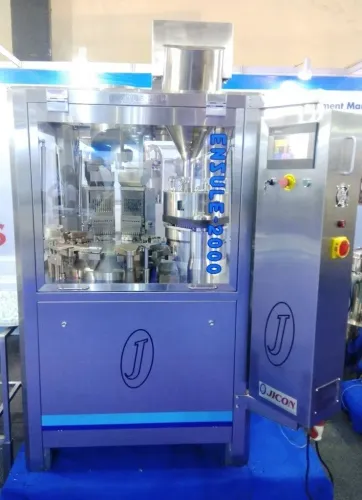
Ask suppliers to clarify whether ENSULE 200, 400, 750, 1500 and 2000 mean capsules per minute, capsules per hour or model designations. Do not compare them until each supplier demonstrates sustained, qualified output on your product.
Request startup yield, steady-state speed, stoppage frequency, rejected capsules, operator count, powder top-up time and output after cleaning and changeover.
| Option | Capacity comparison | Decision test |
|---|---|---|
| One high-speed line | Fewer operators and simpler validation, but one stoppage removes the whole peak schedule | Accept only with proven qualified product-hours per week |
| Two moderate-speed lines | More resilience and parallel product campaigns, but adds validation, maintenance and training | Prefer when several products share the peak schedule |
| Automatic capsule machine for pharmaceutical production | Nameplate speed can conceal rejects, cleaning and downstream limits | Compare saleable output, not instantaneous speed |
A capacity buffer belongs after OEE. Compare qualified product-hours per week, not brochure speed. A second line can outperform one faster capsule filling machine for peak demand when changeovers and release deadlines overlap.
Which dosing system matches your formulation?
Match the dosing system to the actual powder, pellet or mini-tablet blend, not to an empty-machine speed claim. A buyer searching for an automatic capsule filler in Saudi Arabia needs product evidence from a formulation trial.
| Method | Strength | Main risk to test |
|---|---|---|
| Auger | Controlled powder feeding | Bulk-density change and bridging |
| Dosator | Forms a measured powder plug | Unstable powder-bed behaviour |
| Tamping disk | Compresses powder into plugs | Cohesion, compression response and electrostatic charging |
| Pellet system | Handles pellet dosing | Segregation, breakage and inconsistent feed |
Test poor-flowing, low-bulk-density, cohesive, hygroscopic and electrostatic materials at production humidity and temperature. Include variable particle-size blends and high-density components; segregation can change dose uniformity after each hopper refill.
Record fill weights at startup, after replenishment, during a long run and after stoppages. Request these limits for every product family:
- Minimum and maximum fill weight
- Dosage range and accuracy
- Sampling frequency and control limits
- Reject logic for weight failures
For potent or sensitising APIs, assess enclosed transfer, local extraction, safe-change filters, contained waste removal, decontamination access and operator-exposure verification alongside dosing performance. An intended-API-and-excipient trial is more useful than a brochure rating. If the powder bridges, charges to equipment surfaces or loses uniformity after refill, the machine’s rated speed will not protect your batch.
What format, process and quality controls must the filler handle?
Map the full sequence before approving an automatic capsule filling machine in Riyadh: orient empty capsules, separate caps from bodies, form and transfer the dose, close and lock the bodies, eject finished capsules, and reject empty, damaged or incorrectly assembled units. A gap in this chain can pass a defect into packaging.
Ask which sensors detect:
- Empty or partly filled bodies, cap-body separation, telescoped capsules and split shells
- Powder at the lock, incorrect orientation, weight drift and damaged shells
- Every capsule size, shell type and product-specific minimum and maximum fill range
Require documented challenge tests using known defect samples, plus proof that rejected capsules cannot return to the good-product stream. Obtain the change-parts list for each size, including replacement cost and local availability. Measure changeover from the last acceptable capsule to the first acceptable capsule, covering cleaning, line clearance, recipe loading and weight verification.
A fast format change loses its value if manual dismantling makes cleaning slow. Set residue limits through a documented toxicological and product-risk assessment; visual cleanliness alone does not validate cleaning.
| Option | Compare | Decision question |
|---|---|---|
| Automatic | Lower labour and steadier output; greater floor space, validation and downstream loading risk | Can inspection, dedusting, metal detection, packaging and cartoning keep pace? |
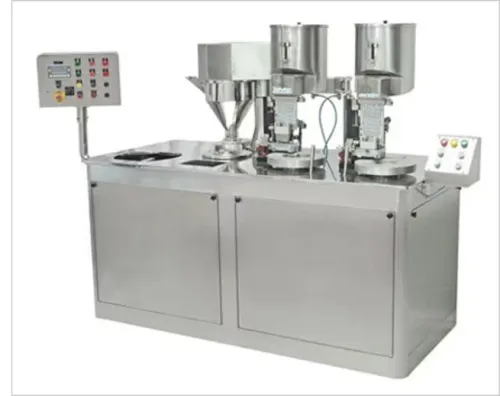
| Semi-automatic | More labour and floor space flexibility; simpler short campaigns and format changes | Does available labour outweigh lower consistency and throughput? |
| Either | Changeover effort, cleaning time and reject control | Can the line avoid starving the filler or overloading inspection? |
Which Riyadh site conditions protect reliable production and release?
Put Riyadh’s conditions in the purchase specification, not in a commissioning note. State supply voltage, phase, 60 Hz frequency, short-circuit protection, ambient-temperature assumptions, compressed-air pressure and utility consumption. For an automatic capsule filler saudi arabia project, specify the ISO 8573-1 class at the point of use, including numeric limits for oil, water and particles.
A central-compressor certificate does not prove clean air at the filler.
Require this qualification package:
- Design qualification, installation qualification, operational qualification and performance qualification.
- Calibration traceability for load cells, pressure instruments, critical sensors and checkweighing equipment.
- Site performance qualification using the intended product; a factory acceptance test cannot replace it.
- Review of electronic recipes, user permissions, audit trails, alarm histories and electronic batch records against site data-integrity rules. Apply 21 CFR Part 11 controls when electronic records support GMP decisions in a U.S.-regulated supply chain; assess EU systems against Annex 11 expectations.
| Evidence or support | Confirm before acceptance | Failure prevented |
|---|---|---|
| Utilities | Voltage, phase, 60 Hz, air quality, pressure and consumption | Trips, sensor faults and unstable separation |
| Local readiness | Arabic and English documents, trained operators, cleaning tools, spare dosing and separation parts, maintenance cover | Extended peak-campaign stoppages |
| Service response | Technician authorization, critical-failure response time, remote-diagnostics limits and validation-record support | Uncontrolled downtime and delayed release |
A response plan must define who contains affected batches, investigates alarms and restores production.
When is an automatic filler the wrong peak-demand decision?
Reject an automatic filler when campaigns are short, volumes are low, formulations change frequently, or powder flow remains unstable after development work. It is also the wrong capsule filling machine for peak demand when trained operators, maintenance cover or cleaning infrastructure are unavailable.
A semi-automatic machine can win when labour is available and automatic equipment’s format parts, validation effort and cleaning systems cost more than the additional saleable output.
| Option | Better fit | Main risk |
|---|---|---|
| Automatic | Repeated products, long campaigns and stable powder flow | Capital, validation, changeover and support burden |
| Semi-automatic | Low volumes, frequent formulation changes and available labour | Lower throughput and greater operator dependence |
Do not approve an automatic capsule filler until the supplier demonstrates, on your product:
- Qualified weekly output after cleaning, changeover, rejects and downstream limits
- Fill-weight range, accuracy, controls and reject logic
- Changeover and cleaning duration, operator count and utility demand
- Containment design, software controls and qualification support
- Change-part scope, critical-spares availability and local technician authorization
For an ensule automatic capsule filling machine, treat the search phrase as a supplier or model identifier, not a performance class or GMP standard. A Riyadh buyer assessing Jicon Technologies Pvt Ltd should also obtain critical-failure response time, remote-diagnostics limits, Arabic and English documentation, and support for validation records.
For an automatic capsule filling machine in riyadh, compare weekly saleable output and total operating risk—not nameplate speed. Ask whether the capsule filling machine for peak demand sustains the schedule after powder replenishment, stoppages and downstream bottlenecks; faster speed cannot remove a constraint.
Related products
 | Capsule Filling Machines Automatic Capsule Filling Machines ENSULE Our ENSULE series of machines are Fully Automatic Capsule Filling machines used to fill powders (in the form of slugs, pellets or mini tablets) in... View product → |
 | Capsule Filling Machines Automatic Capsule Filling Machine ENSULE 2000 ENSULE 1500 ENSULE 750 ENSULE 400 ENSULE 200 Our ENSULE series of machines are Fully Automatic Capsule Filling machines used to fill powders (in the form of slugs, pellets or mini tablets) in... |
Frequently asked questions
How do you calculate the saleable capacity required during a production peak?
Divide the peak-week batch quantity by production hours available before release, then adjust for shifts and divide by OEE: availability × performance × quality.
Which dosing system suits a capsule formulation?
Match dosator, tamping-disk, or liquid dosing to powder flow, cohesion, density variation, fill-weight tolerance, and whether the formulation is powder, pellet, or liquid.
What must an automatic capsule filler control and document?
Check capsule-size range, format parts, changeover time, fill-weight monitoring, empty-capsule rejection, metal detection, interlocks, batch records, and cleaning access.
Which Riyadh site conditions affect capsule-filling reliability?
Verify temperature and relative-humidity control, dust extraction, compressed-air quality, electrical supply, HVAC zoning, cleaning facilities, and material-flow separation.
When is an automatic capsule filler the wrong peak-demand choice?
Choose another approach when the peak is brief, batches change frequently, validation time exceeds the deadline, or projected utilisation cannot support the machine and format-part effort.
Related product
 | Capsule Filling Machines ENSULE: Automatic Capsule Filling Machines Our ENSULE series of machines are Fully Automatic Capsule Filling machines used to fill powders (in the form of slugs, pellets or mini tablets) in... View product → |