
A machine advertised for Riyadh is not necessarily held in Saudi Arabia or ready for dispatch. You can establish the true delivery position, compare SACF I and SACF-II against your formulation and utilities, and set acceptance conditions before committing to an imported or locally delivered unit.
Key takeaways
- Demand Saudi-held stock with a serial number and local dispatch evidence.
- Compare SACF I and SACF-II using output, tooling, controls, and service requirements.
- Test your actual powder, granule, capsule size, and target fill weight before purchase.
- Accept the machine only after documented filling, weight, cleaning, and safety trials.
What does “available in Riyadh” mean for an SACF machine?
“Available in Riyadh” means Saudi-held, serial-numbered stock that can be dispatched locally—not merely an exporter able to quote delivery. A machine in an Indian factory, at a freight forwarder, or listed online is not ready for dispatch from Riyadh; it may still require manufacture, international shipment, customs clearance and installation.
For sacf capsule filling machine availability, request these details in writing:
- Exact model, serial number, stock location and demonstration-unit status.
- Production slot, shipping schedule, estimated arrival and installation date.
- Replacement-part location, including dosing plates, seals and tooling.
- A named Incoterm—EXW, FOB, CIF or DAP—and the party responsible for freight, insurance, Saudi customs clearance, delivery to your plant and commissioning.
The phrase semi automatic capsule filling machine for availability in riyadh can describe two different offers: immediate local availability or an exporter’s ability to quote future delivery to Riyadh. Ask which one applies, and request the importer of record and customs-document responsibility in the same quotation.
“In stock” without a location and serial number proves little; “delivery to Riyadh” without an arrival and commissioning date is a transport estimate, not production readiness.
How should you compare SACF I and SACF-II before ordering?
Choose by demonstrated usable output, not by the SACF acronym or the advertised 10,000–25,000 capsules per hour. Ask the supplier to complete this side-by-side schedule for SACF I and SACF-II, with units and test evidence.
| Item | SACF I | SACF-II |
|---|---|---|
| Capsules/hour | Result using your named formulation, capsule size and fill weight | Same trial conditions |
| Dosing principle and stations | State method and station count | State method and station count |
| Operator work | Capsule loading and powder-replenishment steps | Same details |
| Change parts | Required size-specific plates, tooling and molds | Same details |
| Changeover | Procedure and measured time | Procedure and measured time |
| Fill performance | Range and repeated-test accuracy | Range and repeated-test accuracy |
| Installation | Dimensions and weight | Dimensions and weight |
| Utilities | Voltage, phase, frequency, motor and vacuum-pump ratings | Same details |
| Pneumatics | Air pressure and consumption | Air pressure and consumption |
| Environment | Dust extraction, noise and heat load | Same details |
A semi automatic capsule filling machine leaves capsule loading, powder feeding, cleaning and in-process checks with operators. The headline rate therefore is not a guaranteed production rate; slow replenishment or poor flow can reduce actual output sharply.
Require a trial at the intended capsule size and formulation, including low-density, cohesive or poorly flowing material. Record repeated fill weights, rejected capsules, separation and lock integrity, dust generation, cleaning access and changeover time before treating sacf capsule filling machine availability as a usable production option.
Will the machine handle your chemical powder, granule and capsule combination?
A semi automatic capsule filling machine is not suitable merely because it is available. Cohesive or low-bulk-density powder can bridge and produce incomplete fills; electrostatic powder clings to metal and capsules; abrasive powder wears dosing parts; hygroscopic powder changes flow as it absorbs moisture; dusty material increases operator exposure. Granules can segregate, causing inconsistent dosing.
1. Ask for a trial using your formulation or a representative surrogate with similar particle size, density, flowability and moisture sensitivity. Record repeated fill-weight results, content uniformity where relevant, rejected-capsule rate, shell separation, dust generation and cleaning time.
Test the actual capsule sizes required, including sizes 000 through 5 if applicable; each size may require dedicated dosing plates, tooling or change parts.
2. Request the product-contact material grades, surface finish, seal materials, lubrication points and lubricant type, plus dismantling and cleaning instructions. Test hard gelatin and HPMC shells separately. Confirm shell separation, acceptable dents or deformation, closing and lock integrity, and compatibility with capsule suppliers serving Saudi Arabia and the Gulf.
3. For pharmaceutical, nutraceutical or laboratory use, obtain GMP-related equipment and cleaning documents, calibration procedures and records supporting qualification, including evidence relevant to 21 CFR Part 211 and applicable SFDA expectations. For industrial or agricultural chemicals, assess toxicity, sensitisation, solvent content, corrosivity, operator exposure, grounding and bonding, and combustible-dust risk before choosing a general-purpose machine.
A standard filler is not automatically safe for hazardous powder.
What is the safest buying route for a Riyadh chemical manufacturer?
Send the supplier a specification pack before requesting a price. Include formulation properties, capsule material and size, target fill weight, hourly requirement, site voltage and frequency, available compressed air, dust-control arrangement, room classification and hazardous-area information. Missing process or site data can produce a machine that clears customs but cannot run safely.
Require the quotation to name the importer of record and provide the commercial invoice, packing list, certificate of origin, HS classification, conformity documents and shipping papers. It must state whether customs charges, Saudi taxes, freight, insurance, unloading and internal transport are included. Ask the supplier to identify each included item and service:
- Vacuum pump, dosing plates, molds, dust collector, change parts and spare seals
- Delivery scope, commissioning date, installation work and operator training
- Warranty duration, named response contact, response method and replacement-part route
A capsule filling machine exporter may quote only the base unit, so compare total landed and commissioned cost rather than the export price. Ask a semi automatic capsule machine supplier in Riyadh to confirm the stock location, serial-numbered unit, delivery date, installation scope and after-sales coverage in writing.
Jicon Technologies Pvt Ltd can be approached for written confirmation of stock, delivery, installation and after-sales response, but verify every item against the quotation rather than trusting a generic supplier listing. The buyer should also confirm who handles customs clearance and site readiness before payment.
Related products
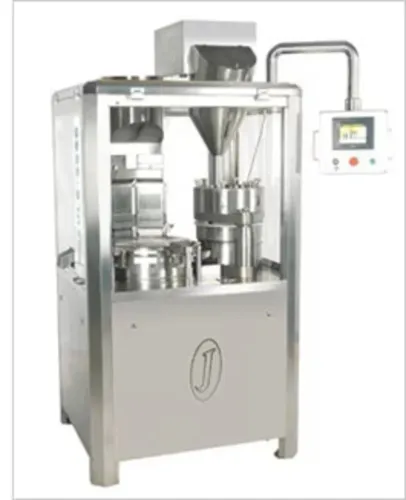
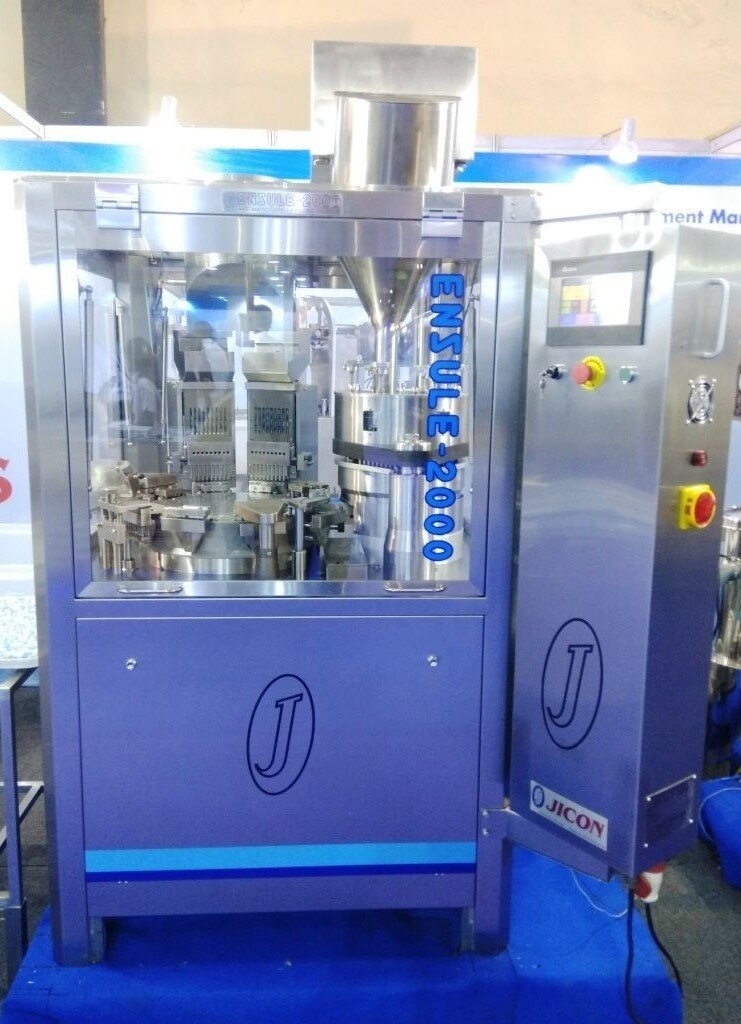
 | Capsule Filling Machines Semi Automatic Capsule Filling Machine SACF SACF I & SACF -II (Semi Automatic Capsule Filling Machines) are designed to fill hard gelatin capsules of all sizes with powders, pellets or granular... View product → |
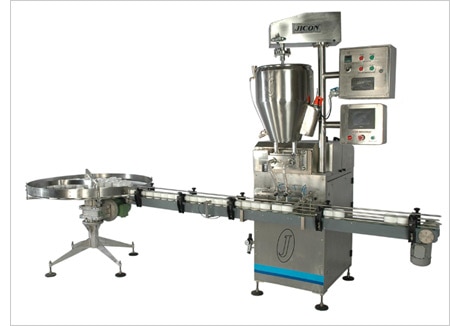 | Container Filling Machines Automatic Container Jar Filling Machine for Ointment and Others High speed automatic multi head container filling machine for filling cream, paste, ointment, wax polish, grease, jam, sauce etc. |
What must be proven during commissioning before the machine is accepted?
A delivered machine is not production-ready until it passes a written site and performance acceptance test. Treat “semi automatic capsule filling machine for availability in Riyadh” as a commissioning question, not proof that the unit is ready for operation.
1. Confirm site readiness before shipment: Saudi-compatible nominal voltage, single- or three-phase supply, 50 Hz frequency, isolator, circuit protection, floor access, service clearance, grounding and bonding. Check vacuum capacity, compressed-air pressure and cleanliness, and the dust-extraction connection.
2. Agree acceptance limits in writing before dispatch. Define repeated fill-weight results, capsule-separation success, closing and lock integrity, rejected-capsule percentage, dust generation, cleaning access and maximum changeover time.
3. Run the trial with the intended shell supplier, capsule size and formulation whenever possible. A different shell or powder can change separation, dosing and rejection results.
4. Record the approved operator settings, calibration method, fill-weight sampling method and cleaning procedure. Test every required change part; a size 000 setup does not prove performance with size 5 tooling.
5. Price the commissioned system, not only the export unit. Include dosing plates and other change parts, utilities, installation, training, freight, insurance, customs, Saudi taxes and imported spare parts.
6. Require a named warranty contact, response time, spare-seal and tooling stock plan, plus a defined procedure for remote diagnosis and on-site service in Riyadh. A capsule filling machine exporter that cannot state these terms has not supplied a complete acceptance plan.
Frequently asked questions
What does “available in Riyadh” mean for a semi-automatic capsule filling machine?
It means the machine is physically held in Saudi Arabia, has a traceable serial number, and can be dispatched locally. An exporter’s quotation or an online listing does not prove Riyadh availability.
How should you compare SACF I and SACF-II before ordering?
Compare their demonstrated output, capsule-size range, dosing arrangement, changeover work, electrical requirements, included tooling, documentation, spare parts, and Riyadh-based service support.
Will an SACF machine handle your chemical powder, granule, and capsule combination?
Confirm compatibility through a trial using your actual material, capsule shell, target fill weight, and batch requirements. Check fill-weight variation, powder flow, segregation, dust generation, capsule closing, and cleaning time.
What must be proven before accepting the machine during commissioning?
Record successful runs at the agreed settings, fill-weight results, capsule closing performance, operating safeguards, cleaning access, changeover steps, and operator training. Tie acceptance to signed test records.
Related product
 | Capsule Filling Machines SACF: Semi Automatic Capsule Filling Machine SACF I & SACF -II (Semi Automatic Capsule Filling Machines) are designed to fill hard gelatin capsules of all sizes with powders, pellets or granular... View product → |