
Rejected blister packs create two separate challenges: recovering usable dosage units without damaging them, and proving whether those units may be reused at all. By the end, you will have a practical workflow, acceptance criteria, equipment-selection checklist, and GMP record structure for making that decision safely.
Key takeaways
- Quarantine rejected blisters and document the recovery decision before opening packs.
- Reject tablets or capsules with contamination, identity concerns, damage, or compromised packaging.
- Diagnose foil, seal, cavity, and product damage before changing machine settings.
- Compare machines by usable recovered product, inspection effort, and GMP qualification needs.
Start with segregation, identity, and a documented recovery decision
Do not open rejected blister packs until you have confirmed identity, sealed the material under quarantine, and assigned a documented decision route. EU GMP Chapter 5 and 21 CFR Part 211.122 require controlled handling of rejected materials and packaging components; 21 CFR Part 211.192 requires a written investigation of unexplained discrepancies and batch failures.
1. Receive the packs against the source blister lot and record quantity, product, strength, batch number, expiry, rejection reason, packaging format, carrier, date, and receiver. Label the container QUARANTINE and prevent mixing with other batches.
2. Inspect sealed packs under Quality-approved instructions. Check exposed dosage units, moisture ingress, contamination, crushed tablets or capsules, damaged seals, missing identity, and unreadable batch numbers. Segregate each batch and rejection reason; record samples, operators, equipment, tooling, and rejected packaging.
3. Quality Unit decides whether to reject and destroy, investigate, or recover. Exposed, wet, contaminated, crushed, unidentified, or untraceable units require rejection and destruction; an unreadable batch number also requires destruction unless identity is conclusively restored through approved records before opening.
4. Use a de blistering machine only to obtain material for controlled investigation or approved reprocessing. A pharma machinery manufacturer de blistering machine for problems remains equipment, not permission to return product to saleable stock. Recovered units stay quarantined until testing, reconciliation, and Quality Unit approval under a justified procedure.
5. Reconcile starting packs, samples, recovered units, empty pockets, damaged units, foreign material, and waste. Record investigation findings, machine and settings, cleaning status, recovery quantity, destruction quantity, and final disposition. Recovery for examination is not release; saleable return needs documented Quality Unit authorization and traceability to the original batch and recovery event.
Set acceptance criteria for tablets, capsules, and blister materials
A blister is physically recoverable only when the pocket, lidding foil, and dosage unit can be separated without transferring fragments or changing the product. Set these limits before running a de blistering machine:
1. Inspect each recovered tablet for edge chipping, capping, lamination, crushing, coating loss, cracks, and visible powder. Reject any unit outside the approved appearance standard or with foil, PVC, PVdC, adhesive, or seal-coating fragments attached.
2. Inspect each capsule for shell cracks, pinholes, leakage, powder loss, deformation, and cap-body separation. Reject capsules with altered fill weight or any shell defect that could compromise identity, dose, moisture protection, or handling.
3. Measure product-specific dimensions, such as tablet diameter and thickness or capsule length, and compare fill weight with the approved specification. Test identity and other required laboratory attributes, including assay, dissolution, or disintegration, rather than treating visual sorting as proof of acceptability.
4. Examine blister pockets and seals for torn film, embedded fragments, adhesive transfer, and seal-coating debris. Use in-process checks to monitor damage rate, powder generation, foreign material, empty pockets, and reconciliation against the quantity loaded.
Opening the blister removes its original barrier against humidity, oxygen, light, and handling contamination. Define a justified maximum hold time from extraction to repackaging, then use an approved primary pack, light and moisture controls, and documented storage conditions. Units failing any criterion require Quality Unit disposition, not automatic return to saleable stock.
Diagnose damage before changing the deblistering process
Do not change the deblistering settings until you identify whether the failure starts at presentation, separation, or transfer. Incorrect guide adjustment, poor feed orientation, weak product support, excessive cutting or peeling force, excessive speed, aggressive vacuum, and transfer impacts produce different damage patterns.
1. Stop the line and segregate every unit from the jam, partially opened blister, and machine path. Do not restart this material into the good-product stream. Record the last accepted check and the quantity potentially affected.
2. Examine tablets for edge chipping, capping, lamination, crushing, coating loss, and powder. Check capsules separately for shell splitting, powder loss, leakage, altered fill, and cap-body separation; excessive compression causes shell damage, while vacuum or transfer impacts can separate the capsule or remove its fill.
3. Inspect feed orientation, guide clearance, pocket support, cutter or peeling surfaces, and transfer points. Look for bent guides, blunt or misaligned cutters, unstable pockets, excessive drop height, and speed settings that leave the dosage form unsupported.
4. Inspect vacuum paths, conveyors, and collection bins for retained dust, coating fragments, capsule powder, foil, or PVC pieces. Clean and document line clearance before release; a pharmaceutical machinery manufacturer should support this inspection.
Document the deviation, suspected cause, settings, affected quantity, samples, cleaning findings, and disposition. Quality must decide whether material is reprocessed, held for investigation, or destroyed; never return jammed, contaminated, or damaged units by operator judgment.
Compare manual, semi-automatic, and automatic recovery on useful output
Choose manual deblistering for small, high-risk lots where inspection matters more than throughput. Use semi-automatic equipment for recurring rejects with moderate volume. Select automatic recovery only when feed presentation, product protection, and segregation are controlled across the product range.
| Option | Good units per hour and rejected-pack volume | Labour, yield, damage, and dust | Cleaning, stoppages, and changeover |
|---|---|---|---|
| Manual | Lowest output; small lots | Highest operator time and inspection labour; variable yield and damage; dust depends on opening technique | Simple cleaning, but jams and reconciliation are slow; fastest format change |
| Semi-automatic | Medium output; regular moderate lots | Reduced labour; better repeatability, yield, and dust control than manual | Accessible cleaning and manageable stoppages; moderate changeover |
| Automatic | Highest potential output; large, repeatable lots | Lowest handling labour; controlled damage and dust when qualified | Longer line clearance and cleaning; stoppages lose more output; changeover depends on tooling |
Nominal speed is the wrong buying metric: calculate good units per hour after rejects, stoppages, cleaning, reconciliation, inspection, and line clearance. A slower pharmaceutical machines manufacturer solution can deliver more saleable output by preventing tablet chipping, capsule splitting, dust sorting, and rework.
Physically or electronically segregate accepted units, damaged units, empty pockets, and foreign material; a machine count alone is not reconciliation.
Qualify the pharma machinery manufacturer’s system across feed orientation, product-support geometry, cutting or peeling force, speed, vacuum, and collection conditions. Challenge worst-case blister formats and products, then define jam isolation, inspection, cleaning, and restart rules. Record damage, yield, dust, and changeover results at each operating range.
Build the buyer’s machine-fit and GMP qualification checklist
Give the supplier a format dossier before comparing a de blistering machine. Without it, a successful trial on one blister can hide crushing, foil carryover, or capsule leakage on another.
- Tablets: diameter, thickness, shape, coating, and maximum permitted damage, including edge chips, capping, lamination, powder generation, and coating loss.
- Capsules: size, shell type, fill sensitivity, and acceptable leakage limit; state whether shell splitting or cap-body separation makes the unit unacceptable.
- Blisters: length, width, cavity pitch, pocket depth, seal width, pack orientation, PVC/PVdC or aluminium forming material, aluminium lidding foil, foil stiffness, and pack format.
| Supplier response | What to require | Evidence to review |
|---|---|---|
| Product trial | Recovery and damage rates for every product family and format | Counts of intact units, damaged units, foil or plastic fragments, and waste |
| Tooling and settings | Tool identification, adjustment ranges, feed orientation, support geometry, cutting or peeling force, speed, vacuum, and collection conditions | Approved setting sheet covering worst-case formats |
| Capacity and services | Throughput, compressed-air pressure and consumption, electrical supply, changeover time, and stoppage recovery | Recorded good units per hour, not nominal speed |
| Hygiene and construction | Cleaning method and product-contact materials | Cleaning instructions and material certificates |
A pharmaceutical machinery manufacturer such as Jicon Technologies Pvt Ltd should be judged on this documented fit, not advertised speed. A pharmaceutical machines manufacturer must also define first-off approval before production recovery, then record tool identification, line clearance, reconciliation, cleaning verification, and traceability from the original batch to each recovery event.
Reject any demonstration that lacks signed qualification evidence.
Related product
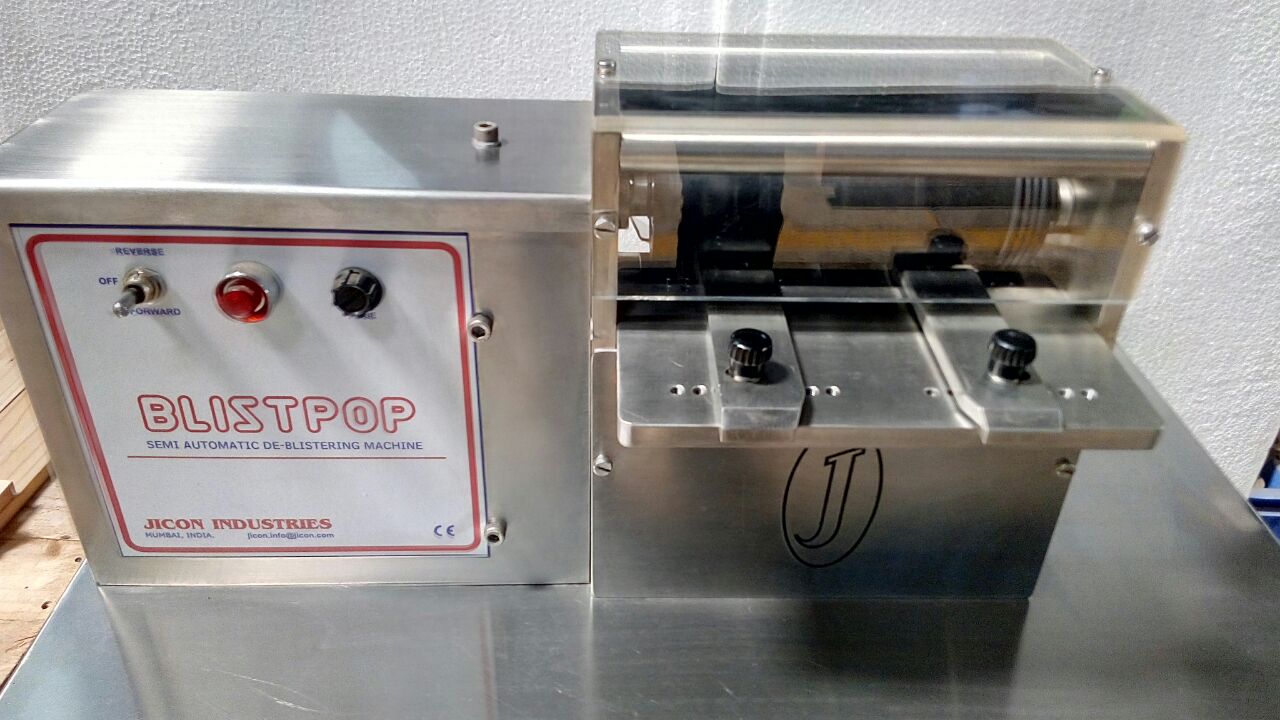 | Accessories & Ancillary Equipments Deblistering Machine for Tablets and Capsules BLISTPOP BLISTPOP is a simple de-blistering machine which is used to recover tablets / capsules / dragees from damaged or incomplete blister packs. |
Frequently asked questions
What must you do before opening rejected blister packs?
Confirm product identity, seal the material under quarantine, and assign a documented recovery, rejection, or investigation route.
What acceptance criteria apply to recovered tablets and capsules?
Define criteria for identity, appearance, damage, contamination, count, and traceability, plus separate criteria for blister foil and forming material.
How can you diagnose deblistering damage?
Inspect tablet or capsule defects alongside foil tears, seal damage, cavity deformation, and machine contact points before changing the process.
How should you compare manual, semi-automatic, and automatic recovery?
Compare usable recovered units, operator inspection time, product loss, throughput, segregation controls, and documentation workload.
What belongs on a deblistering machine GMP qualification checklist?
Check product-contact materials, cleanability, guards, reject segregation, line clearance, traceability, operating limits, and installation, operational, and performance qualification records.