
Rejected blister strips contain two separate problems: recoverable tablets or capsules and packaging waste that may still carry pharmaceutical residue. By the end, you will know how to assess format compatibility, recovery performance, cleaning controls, qualification support and the true cost of buying equipment in Chandigarh.
Key takeaways
- Use de-blistering only under an approved recovery or destruction procedure.
- Test every blister format, dosage form and foil structure before purchase.
- Measure intact-dose recovery and waste separation, not only hourly speed.
- Compare validation, cleaning, containment, service and spare-part costs.
Where de-blistering fits in the pharmaceutical workflow
A rejected blister strip enters a de blistering machine only under an approved recovery or destruction procedure. The machine separates the tablet or capsule from its formed pocket and lidding foil, while the dosage unit exits separately from PVC, PVDC, aluminium foil, paper, and adhesive waste.
1. Identify and segregate the batch before feeding it. Record the product name, strength, batch number, expiry date, quantity, and reason for rejection; never combine different products or strengths in one run.
2. Feed the strip through the opening or extraction section. The equipment breaks the seal or displaces the dosage unit from each pocket without treating every recovered unit as usable product.
3. Collect the tablets or capsules in a labelled, covered container. Inspect for chipped edges, cracks, crushed shells, coating damage, powder, foreign material, and contact with other products.
4. Collect foil and formed plastic separately. These components can retain pharmaceutical residue, so label, store, and dispose of them through the site’s controlled waste procedure rather than assuming they are clean recyclables.
5. Reconcile the feed quantity against intact units, damaged units, powder, and residual product in the strip. Investigate unexplained loss or mixed waste before closing the batch record.
A recovered unit can return to production only after documented quality assessment and an authorised disposition decision. An approved rework procedure must define inspection, identity confirmation, packaging replacement, and release controls.
Expired, contaminated, unidentified, or damaged tablets and capsules go to disposal; units that pass inspection may instead be sent for controlled repacking or further examination.
Match the machine to your blister formats and dosage forms
A machine that opens one blister format cleanly can damage another. Before ordering a de blistering machine, send the supplier representative samples of every pack you expect to process, including rejected strips with crushed pockets, missing tablets and distorted seals.
| Feature | Confirm before ordering | Failure if ignored |
|---|---|---|
| Pack dimensions | Pocket depth, strip width, pack length, cavity pitch and overall layout | Guides misalign, leaving tablets in pockets or crushing them |
| Materials | PVC, PVDC, aluminium lidding foil, paper-backed components and cold-form Alu-Alu support | Cutters tear laminate or leave excessive foil and product residue |
| Thickness | PVC forming-film thickness and aluminium lidding thickness | Feed rollers slip, or punches apply excessive force |
| Dosage form | Round, oval, capsule, scored, coated, dragee, soft, brittle and irregular units | Chipping, cracking, peeling or capsule deformation |
| Format changes | Interchangeable guides, punches, rollers, cutters and feed tooling; changeover time and storage | Each new format needs costly modification or extended downtime |
Confirm the machine’s adjustment range, not just its maximum pack size. Ask for marked settings for pocket depth, feed height, cutting pressure and product discharge, plus a written list of included and optional format parts.
Run a factory test using your smallest, largest, hardest and most fragile products. Record intact recovery, chipped units, powder, residual tablets in pockets and mixed waste for each format; a high feed rate is useless if the recovered dosage units are damaged.
Measure useful recovery instead of advertised speed
A fast de blistering machine is a poor choice if it damages more dosage units than it recovers. Compare machines using recoverable, intact units per hour from the same blister format, not the supplier’s empty-pack feed rate.
| Measure | What to record during the test | Why it matters |
|---|---|---|
| Gross throughput | Blister strips processed per hour | Shows feeding capacity, not usable output |
| Intact recovery | Unbroken tablets or capsules recovered per hour and as a percentage of input | Measures potential product value |
| Product loss | Broken or chipped units, powder generated, and dosage units left inside pockets | Reveals hidden waste and handling risk |
| Scrap separation | Foil, PVC or PVDC, and mixed waste produced | Shows disposal effort and contamination risk |
| Labour requirement | Operators, loading time, format changeover, cleaning, inspection and rework hours | Exposes savings that speed claims omit |
Put these figures into the factory acceptance test for every specified format. Include PVC-aluminium and Alu-Alu packs if both will run on the de blistering machine; a result from one structure does not prove performance on another.
Calculate useful recovery as intact units accepted after documented inspection, not every tablet discharged from the outlet. Recovered product still needs batch traceability, a recorded rejection reason and quality disposition before reuse, inspection or disposal.
Compare the recovered product value and avoided disposal cost against changeover labour, cleaning, maintenance, validation and quality-control time. A slower machine with 98% intact recovery and one operator can outperform a faster model that produces powder, mixed waste and a second inspection shift.
Specify cleaning, containment and qualification controls
Treat product recovery as a controlled GMP operation, not a simple opening step. Specify stainless-steel product-contact surfaces, smooth welds, tool-less or controlled-access parts, and powder traps that the operator can see and clean without dismantling half the machine. Hidden powder becomes the next batch’s contamination source.
Require documented controls for:
- Segregated product and blister-waste paths, with sealed collection containers labelled by product, batch number and rejection reason.
- Dust containment at the feed, opening and discharge points, plus extraction that cannot blow powder into the room or another product path.
- Lubricant exclusion from product-contact zones, with food- or pharmaceutical-grade lubricants identified in the maintenance procedure.
- Foreign-body prevention through guarded tooling, captive fasteners, intact screens and documented line-clearance checks.
- Interlocked guards and accessible emergency stops; never accept a design that lets operators reach moving cutters during operation.
- Cleaning instructions covering powder traps, discharge chutes, rollers and change parts, with visual inspection and, where required, swab or rinse verification.
- Status labels and batch reconciliation so recovered tablets or capsules cannot mix with approved stock, another strength or another batch.
Ask the pharmaceutical machinery manufacturer for a cleaning matrix, material certificates, risk assessment, spare-parts list and changeover procedure. Define how PVC, PVDC, aluminium foil, paper and adhesive waste containing drug residue will be labelled, stored and disposed of; separation does not make it automatically recyclable.
Before release, demand design qualification, installation qualification, operational qualification and performance qualification support. The protocol should challenge each approved format, demonstrate recovery and containment, and record acceptance criteria before routine use.
Compare buying routes and total ownership cost in Chandigarh
The lowest quote is not automatically the lowest-cost route. Compare the machine, format tooling, qualification work, installation, utilities, training, spare parts and service response over its planned life.
| Route | Cost and responsibility | Choose it when |
|---|---|---|
| Direct OEM | Clearer design responsibility, factory support and qualification documentation; freight and site coordination remain yours | One machine has a defined format and your team can manage installation |
| Authorised distributor or integrator | Adds local coordination for utilities, training, service and several connected machines | You need one party to manage a complete packaging line in Chandigarh |
| Refurbished equipment | Lower capital cost, but format parts, obsolete controls, repairs and requalification can erase the saving | The machine history, guarding, electrical compliance and replacement parts are verifiable |
A pharmaceutical machinery manufacturer should price interchangeable guides, punches, rollers and feed tooling separately, including lead time. Ask whether compressed-air consumption, extraction, footprint, service clearances and washdown limits fit your facility before signing.
Whether you buy from a pharmaceutical machines manufacturer, distributor or integrator, make the contract identify:
- Exact blister formats, acceptance tests, intact-recovery target, product-loss limit and usable throughput
- DQ, IQ, OQ and PQ support, operator training, manuals and calibration records
- Warranty duration, response time, preventive maintenance, critical spares and obsolete-control replacement
- Tooling prices, delivery dates, installation scope, utilities and change-control responsibilities
- For refurbished equipment: serial history, prior products, refurbishment work, electrical and guarding checks, and the documentation needed for requalification
Jicon Technologies Pvt Ltd is worth asking for a written format-tooling and qualification scope rather than accepting a machine-only quotation.
Related products
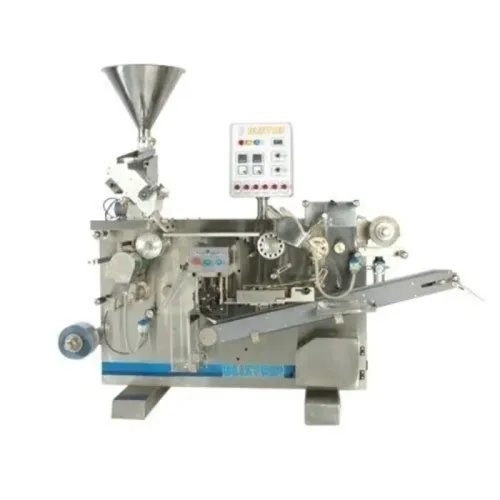
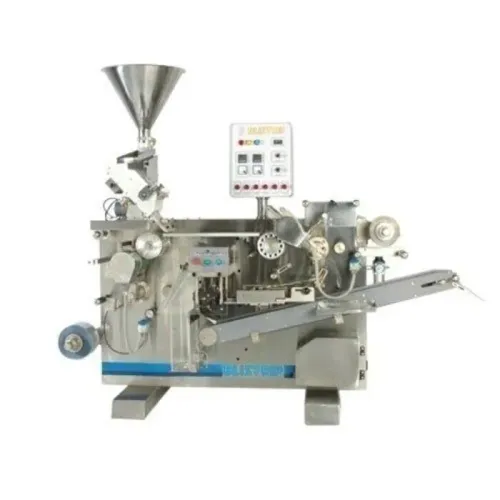
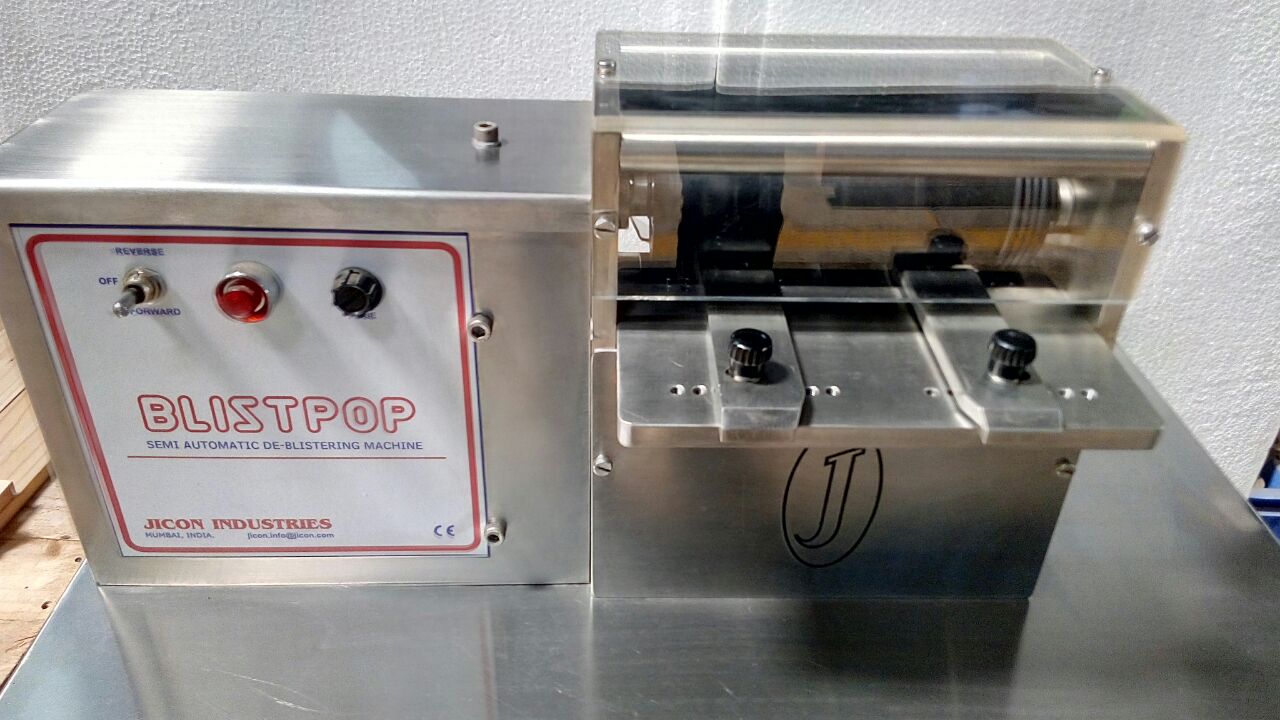 | Accessories & Ancillary Equipments Deblistering Machine for Tablets and Capsules BLISTPOP BLISTPOP is a simple de-blistering machine which is used to recover tablets / capsules / dragees from damaged or incomplete blister packs. |
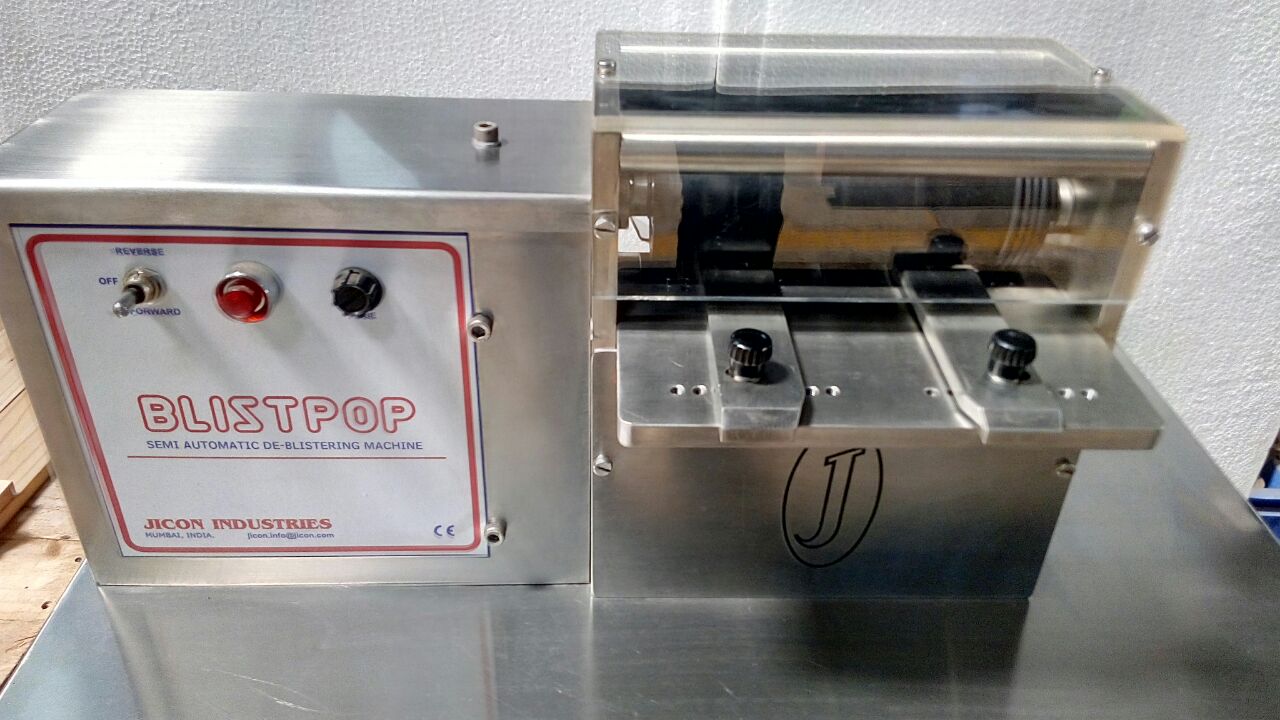 | Accessories and Ancillary Equipments BLISTPOP (De-Blistering Machine) ₹1 BLISTPOP is a simple de-blistering machine which is used to recover tablets / capsules / dragees from damaged or incomplete blister packs. View product → |
Frequently asked questions
Where does a de-blistering machine fit in pharmaceutical production?
It processes rejected blister strips under an approved recovery or destruction procedure, separating tablets or capsules from blister materials before the next controlled step.
How do you match a de-blistering machine to your products?
Check the machine against your blister dimensions, PVC or PVDC forming film, aluminium lidding foil, adhesive structure, tablet shape and capsule size. Test representative samples before ordering.
How should you measure de-blistering machine performance?
Record intact-dose recovery, damaged-dose rate, material separation, throughput at your actual feed condition and stoppage time. Advertised speed alone does not show useful output.
What should you compare when buying in Chandigarh?
Compare a new machine from a pharmaceutical machinery manufacturer with a used or refurbished unit by checking purchase price, installation, validation documents, cleaning design, containment, training, service response and spare parts.