
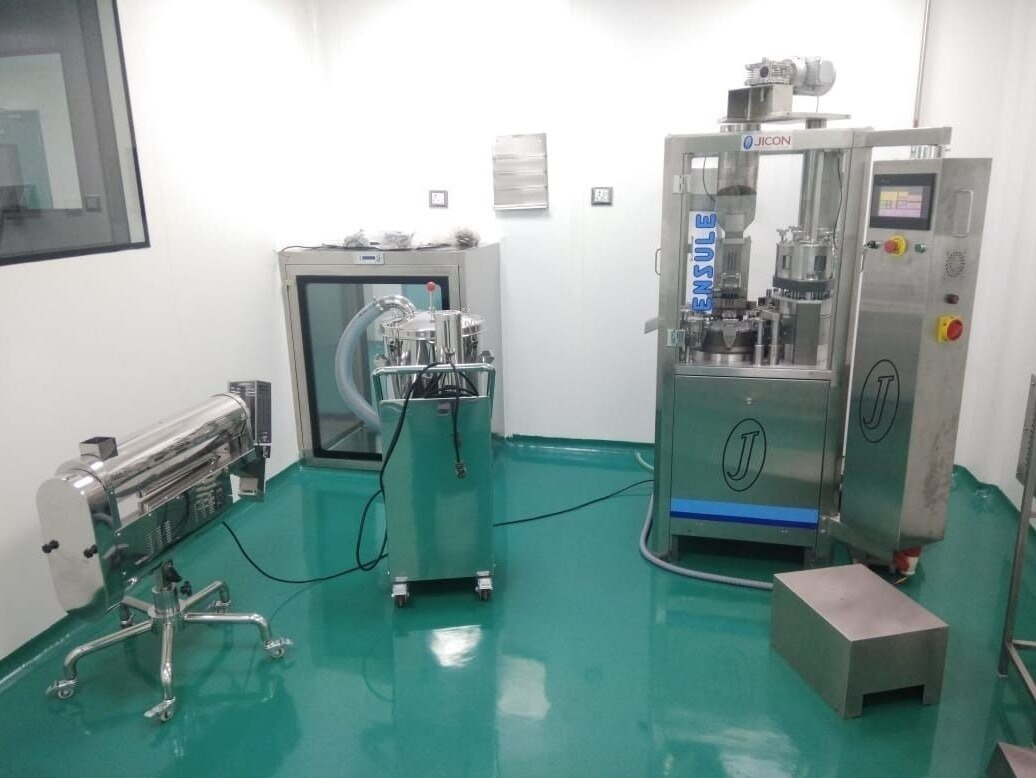
A chemical package can look perfectly sealed and still lose solvent, admit moisture or fail after temperature cycling. You will be able to match the pack and chemical to a suitable leak-test principle, define a defensible acceptance limit, and challenge the complete test system before relying on its results.
Key takeaways
- Define the failure consequence before selecting pressure, vacuum, tracer-gas, or dye testing.
- Match the detection method to the defect size, pack material, geometry, and chemical.
- Specify leak rate, sensitivity, cycle time, chamber dimensions, and chemical compatibility.
- Qualify the apparatus with calibrated reference leaks and aged finished packs.
Define the leak you must detect before choosing a test
A chemical-packaging leak test must prove that the finished pack retains its contents and excludes damaging ingress at a defined defect size or leak rate. Do not accept “no pressure change” as the specification until you state the failure consequence: hazardous chemical escape, volatile-solvent loss, oxygen or moisture ingress, or microbial entry.
The acceptable limit must be justified by that consequence and a package-specific challenge study.
| Defect to define | What the test must prove | Failure if missed |
|---|---|---|
| Gross opening | No visible or rapid gas or liquid escape through a hole, split or open seal | Immediate product loss or exposure |
| Fine leak | Leakage stays below a stated flow rate under specified pressure, vacuum and temperature | Slow solvent loss or oxygen and moisture ingress |
| Seal-channel leak | Every heat seal, weld, cap, liner or closure maintains a continuous barrier | Contamination enters through an apparently intact joint |
| Lifecycle defect | The pack remains within the limit after ageing, transport vibration, handling and temperature cycling | A pack passes at sealing but fails in distribution |
Record the critical defect, test pressure or vacuum, temperature, dwell time and reject threshold before selecting a leak test apparatus. Qualify the complete fixture, seals, software and decision algorithm with reference leaks and positive-control defective packs; calibrating only the pressure sensor proves little.
Flexible pouches and sachets need special scrutiny because folds, film movement and chamber compression can hide or mimic a leak. Control solvent vapour, foaming and temperature, since each can change the measured result.
Match the detection principle to the package and defect
The defect decides the method: use a deterministic test for repeatable production decisions, and reserve visual or dye methods for gross leaks or investigations.
| Method | Detection principle | Use it when |
|---|---|---|
| Vacuum decay | Measures chamber-pressure rise as gas escapes from a sealed pack | You need non-destructive testing of rigid bottles, vials, tubes or HDPE containers; verify the recipe for flexible pouches because film movement and folds create false results. |
| Pressure decay | Measures pressure loss from a pressurised package | The pack tolerates internal pressure and you need a non-destructive alternative to vacuum testing. |
| Bubble emission | Shows escaping gas as bubbles during pressurisation and immersion, as described in ASTM F2096 | You need to locate a gross leak quickly. It is generally destructive and does not quantify fine-leak rate. |
| Dye ingress | Uses coloured liquid entering through a leak path | You need a simple destructive investigation of pouches, sachets or welded liners, and dye exposure will not invalidate the pack. |
| Tracer gas | Detects helium or another tracer escaping through very small defects | You need high sensitivity for critical seals or exceptionally small leaks and can justify specialised equipment and gas handling. |
Select a complete leak test apparatus, not merely a calibrated pressure sensor. Challenge the fixture, seal, software, cycle and reject algorithm with a reference leak at the intended threshold. For flexible chemical packs, include positive-control defective packages; a rigid-container vacuum recipe will not transfer reliably without package-specific development.
Check chamber size, pack geometry and chemical compatibility
A 150 mm or 300 mm chamber is suitable only when its usable internal diameter, height and sealing surface accommodate the finished pack without contact or deformation. Compare those dimensions with the largest pack, fixture, pouch folds and required clearance; the label on the chamber is not proof of capacity.
- Measure the pack in its test orientation, including cap, closure, weld bead and protruding features.
- Leave enough clearance for the lid, gasket and vacuum path; a container touching the chamber wall can create an unstable seal or mask a leak.
- Test the smallest headspace and largest product volume, because package volume changes vacuum-decay response.
- For pouches, sachets and welded liners, check whether vacuum pulls folds together, shifts the seal or traps air. A rigid-bottle recipe can produce false passes or false failures.
- Confirm that the chamber, lid, gasket, tubing and sensors resist the chemical, vapour and cleaning agents used in production.
- Run trials with filled packs at the intended temperature and orientation, not empty samples alone.
Choose the 150 mm chamber when every pack and fixture fits with repeatable clearance. Choose 300 mm when pack width, multiple units, or flexible-pack movement exceeds that envelope; the larger chamber is not automatically more sensitive.
Require package-specific settings for vacuum level, dwell and acceptance limit under ASTM F2338 development, then verify that results remain stable after chemical exposure and temperature cycling. A pharmaceutical machinery manufacturer should document these trials rather than rely on nominal chamber size.
Specify the machine and supplier around measurable performance
Do not buy on chamber diameter or a stated vacuum range alone. Require the supplier to document a package-specific operating window, because film movement, folds, trapped air and chamber compression can make a flexible pouch appear leaky—or hide a real defect.
1. Identify every intended pack: blister, strip, sachet, pouch, bottle, vial, tube, HDPE container and welded liner. Request maximum pack dimensions, fixture or desiccator clearance, product fill volume and evidence that the method works on the thinnest wall and most flexible film.
2. Specify the test recipe in numbers: test medium, preconditioning temperature, vacuum level, pull-down time, stabilisation time, measurement duration, acceptance limit and reject response. Ask how the instrument distinguishes pressure change caused by a leak from solvent evaporation, foaming or temperature drift.
3. Require method-development data for flexible packs, not a copied rigid-bottle recipe. Ask for reference-leak sizes, repeatability, false-reject results and instructions for placing the pack, applying vacuum and identifying bubble emission or pressure decay. ASTM F2096 bubble testing is a gross-leak, usually destructive method, not a fine-leak rate.
4. Request validation records covering the sealer and tester together under ISO 11607-2, including seal temperature, pressure, dwell time, tooling condition, material lot and operating limits. Include chemical-compatibility results for elastomers and sealants.
For electronic recipes, alarms or reject records, ask the pharma machinery manufacturer for user access controls, protected audit trails, change history, traceability and backup recovery. Jicon Technologies Pvt Ltd should document these points for any pharmaceutical machinery manufacturer leak test apparatus for chemical packaging, including an LTA-150 or LTA-300 evaluation.
A supplier that cannot define ageing, transport and temperature-cycle challenges has not documented lifecycle performance.
Related products
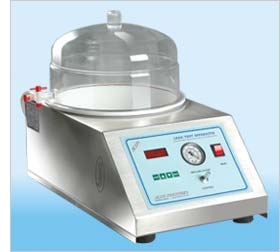 | Accessories & Ancillary Equipments Leak Test Apparatus for Pharmaceutical Blister packs and others LTA -150 and LTA - 300 are Leak Test apparatus models by Jicon Technologies. 150 and 300 denotes the diameter of the dessicator. |
 | Accessories and Ancillary Equipments Leak Test Apparatus (LTA-150/ 300) ₹1 LTA -150 and LTA - 300 are Leak Test apparatus models by Jicon Technologies. 150 and 300 denotes the diameter of the desiccator. View product → |
Qualify the method from reference leak to finished-pack ageing
Set the reject limit with a calibrated reference leak that represents the smallest critical defect, not with the sensor’s resolution. Challenge the complete leak test apparatus at that threshold, because fixture seals, package supports, vacuum level, dwell time, software and the decision algorithm all affect detection.
Qualify the method in this order:
- Test sound packages and packages containing the reference leak at the intended production speed. Record detection rate, false rejects and repeatability.
- Challenge the system with positive-control defective packages made by the same sealing process. Confirm that the apparatus rejects them after normal handling.
- Compare failed units with an independent confirmation method, such as dye ingress or microscopic examination, to prove that the signal represents a real breach.
- Repeat the study across the approved package volume, headspace, material and temperature range. ASTM F2338 vacuum decay responds to package flexibility, chamber sealing, temperature and dwell time, so a nominal vacuum range proves little.
- Run the test after the defined ageing and distribution challenges, then verify that the same critical defect remains detectable.
Age finished packs through the intended shelf-life conditions and apply transport or handling challenges that reflect actual distribution. Check for seal creep, chemical attack, punctures and temperature-cycle damage. Inline 100% inspection removes individual rejects at production speed; laboratory sampling diagnoses trends, but no sampling plan rescues a method that misses the critical leak.
Flexible packs need package-specific validation because folds and film movement can mask leakage or create false signals.
Frequently asked questions
What must you define before choosing a chemical packaging leak test?
Define the failure consequence and the defect or leak rate that the finished pack must detect, including chemical escape, solvent loss, oxygen or moisture ingress, or microbial entry.
How do you choose a leak detection principle for chemical packaging?
Match the principle to the package and defect: pressure or vacuum decay for suitable rigid packs, tracer gas for very small leaks, and dye testing for visible channel defects.
What should you check before buying a leak test apparatus?
Check chamber dimensions, pack geometry, fixture design, test pressure or vacuum range, cycle time, sensor resolution, and compatibility with the chemicals and vapours involved.
How do you qualify a pharmaceutical machinery manufacturer leak test apparatus?
Challenge the machine with calibrated reference leaks, then confirm detection on representative finished packs before and after ageing, handling, and chemical exposure.