
A fluid bed dryer works well only when your wet feed can form a permeable, fluidizable bed and tolerate the required heat and airflow. You will be able to match the dryer to your ingredient, define a measurable process endpoint, compare alternative technologies and assess a Chandigarh supplier without relying on broad claims about low-temperature drying.
Key takeaways
- Confirm your ingredient forms a permeable, fluidizable bed before choosing this dryer.
- Specify inlet temperature, airflow, moisture target and heat sensitivity for dairy powders.
- Prove the endpoint with product moisture, water activity and uniformity results.
- Choose batch drying when recipes, small lots or frequent product changes matter.
Is a fluid bed dryer suitable for your food ingredient?
A fluid bed dryer is suitable only when your feed can form a permeable, fluidizable bed as loose particles, wet granules or a defined powder. Air passes through a perforated product bowl or distributor, lifts the particles, and carries evaporated moisture into the exhaust stream.
This makes the process useful for milk powder, whey powder, starch, spices, extracts, granules and other particulate ingredients.
- Confirm the physical form. Test whether the material suspends evenly rather than settling into a dense layer. Very fine, cohesive, sticky or irregular particles can channel, defluidize or agglomerate instead of drying uniformly.
- Match the equipment to the flow problem. Vibration, mechanical agitation or modified air distribution can improve suspension. A prior granulation or agglomeration stage may be necessary when the powder will not fluidize reliably.
- Define the process objective. Moisture drying removes water from an existing particle. Top-spray processing can agglomerate or granulate powder, while bottom-spray processing supports coating or encapsulation. Instantizing uses controlled agglomeration to improve wetting and dispersibility.
- State the required outcome before choosing a fluid bed dryer for food processors in Chandigarh: drying, instantizing, granulation, coating or a combined process. A machine selected for drying alone will not automatically deliver coating or agglomeration performance.
Assess the actual feed in a representative trial. Particle size, moisture, stickiness and airflow response matter more than the ingredient name on the purchase specification.
What must you specify for dairy powders and other sensitive feeds?
Sizing starts with the feed, not the chamber volume. Give the supplier a complete product brief before requesting a fluid bed dryer for dairy ingredients:
- Batch mass and bulk density, both loose and tapped where relevant
- Particle-size distribution, including fines and oversized particles
- Initial moisture, final moisture and target water activity
- Stickiness, fat content, hygroscopicity and heat sensitivity
- Allowable product temperature and required cycle time
Lactose-rich powders need special control because amorphous lactose becomes rubbery when temperature rises above its moisture-dependent glass-transition temperature. Fat-containing powders can smear or foul filters, hygroscopic materials can reabsorb water during cooling, and heat-sensitive cultures can lose viability. Do not approve a food processing fluid bed dryer manufacturer’s proposal on moisture results alone.
Require application trials that measure protein solubility, wettability, dispersibility, bulk density and protein functionality, alongside moisture and water activity. The trial must establish product-temperature limits and the moisture history that prevents sticking, denaturation or loss of performance.
Include Chandigarh’s seasonal design conditions—summer heat, monsoon humidity and winter ambient air—in the basis of design. Specify inlet-air filtration, dehumidification, final filtration, exhaust filtration and the pressure relationships between clean-air, product and exhaust sides. Do not accept an assumed temperature range or airflow figure; obtain both from a validated trial or a documented equipment specification.
If pathogen reduction is claimed, demand separate organism-, product- and equipment-specific time-temperature validation.
How should the drying cycle be controlled and its endpoint proved?
Prove the endpoint with a defined moisture history, not an outlet-temperature reading. A fluid bed dryer for food processors in chandigarh needs a recipe that links airflow, air conditions, product temperature and sampling results to the finished specification.
1. Load the measured batch and record its starting mass, moisture content, particle-size distribution and bulk density. Preheat the air-handling system, including filtration and dehumidification, before product contact.
2. Start fluidisation at the lowest airflow that lifts the bed uniformly. Excessive superficial air velocity entrains fines, loads the exhaust filters and reduces product recovery; insufficient velocity leaves dead zones, poor suspension and uneven drying.
3. Raise inlet-air temperature and set humidity in controlled stages. Use a higher initial drying drive only when the product tolerates it, then reduce the temperature or increase humidity to limit case hardening, surface sealing and overdrying.
4. Record airflow, bed pressure drop, inlet and exhaust temperature, exhaust humidity and product temperature throughout the cycle. Set a product-temperature limit for lactose-rich, fat-containing or heat-sensitive materials, and retain the moisture history rather than relying on the final reading.
5. Sample from several bed locations at defined time points, then test moisture content, water activity and product temperature. Add particle-size distribution or bulk-density targets when agglomeration, breakage or filling performance matters.
6. Stop drying only against validated process limits and a sampling plan that demonstrates uniformity. Cool the bed with controlled, clean air before discharge; otherwise condensation or moisture pickup can undo the endpoint.
Drying is not automatically a microbial kill step. Pathogen reduction requires organism-, product- and equipment-specific time-temperature validation, including the moisture conditions that the validated process uses.
When is batch fluid-bed drying the better choice than other methods?
Choose batch fluid-bed drying when you handle varied products, wet granules or changing recipes rather than one stable, high-volume feed. It dries loose particles, but it also processes wet granules and engineered agglomerates; the air settings must preserve the granule instead of breaking it apart.
| Option | What it means | When it applies |
|---|---|---|
| Batch fluid bed | Flexible recipes and rapid heat and mass transfer, with loading, unloading, cleaning and changeover time | Multiple products, wet granules and variable batch sizes |
| Tray drying | Static product on trays with long residence time | Simple, low-throughput products when slow drying is acceptable |
| Vacuum drying | Lower boiling temperatures under reduced pressure, with slower processing and more complex equipment | Oxygen-sensitive or heat-sensitive materials |
| Spray drying | Atomises a liquid, emulsion or slurry into a powder | Feeds that are not already particulate |
| Continuous fluid bed | Controlled feed, moisture and particle-size distribution through a steady process | Stable, high-throughput products with consistent feed conditions |
A batch FBD can show batch-to-batch variation, so weigh loading, air conditions and endpoint checks carefully. Require cleanable product-contact surfaces, no powder traps or dead legs, drainability where wet cleaning applies, controlled filter access and cleaning records.
Ask the food processing fluid bed dryer manufacturer for dust testing covering Kst, maximum explosion pressure, minimum ignition energy and minimum explosible concentration where applicable. Use those results to specify venting, suppression, isolation and ignition controls.
How do you evaluate a fluid-bed dryer manufacturer in Chandigarh?
Judge the supplier by a documented performance review, not by catalogue labels or the phrase “low temperature.” Ask for records that show how the proposed dryer will handle your powder, utilities, hygiene risks and dust load.
- Product-contact material grades, weld and surface-finish details, hygienic-design drawings, powder-trap and dead-leg controls, and the cleaning and changeover method.
- Inlet-air filtration, dehumidification, final filtration, exhaust filtration, air-quality limits, airflow range, utility consumption, pressure-drop limits and filter pressure-drop alarm points.
- Guaranteed or trial-based moisture uniformity, product recovery, exhaust dust loading, filter loading and provisions for returning collected fines.
- A dust-hazard assessment covering Kst, maximum explosion pressure, minimum ignition energy and minimum explosible concentration where applicable, followed by specified venting, suppression, isolation and ignition-control measures.
- A factory acceptance test using your actual product or a representative formulation, with agreed measurements for moisture, water activity, product temperature, bulk density, recovery, cycle time and filter loading.
The phrase pharmaceutical machines manufacturer fluid bed dryer food processors in chandigarh should lead you to these records, not to a marketing claim. Ask every bidder to use identical application data, hygienic-design evidence and FAT criteria. Jicon Technologies Pvt Ltd belongs in that comparison only if its proposal supplies the same evidence and test commitments.
Reject a bid that reports outlet temperature alone; it cannot prove finished-product moisture, water activity or uniformity.
Related products
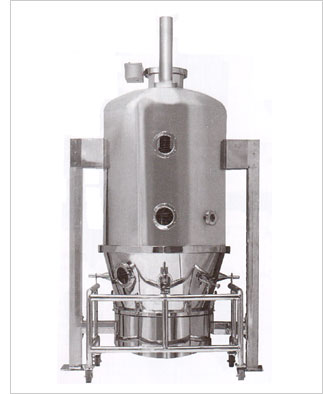 | Process Equipments FBD (FLUID BED DRYER) Salient Features: # Better productivity and lesser drying time. # Less handing, more hygienic. View product → |
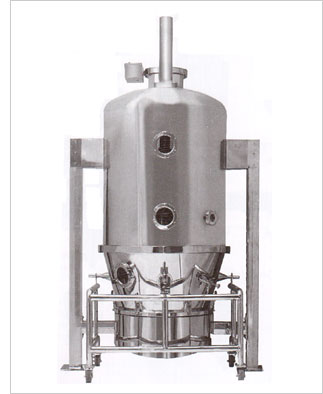 | Process Equipments FBD (FLUID BED DRYER) FBD (FLUID BED DRYER) Salient Features: # Better productivity and lesser drying time. # Less handing, more hygienic. |
Frequently asked questions
Is a fluid bed dryer suitable for every food ingredient?
No. The feed must form a permeable, fluidizable bed as loose particles, wet granules or a defined powder. Sticky pastes, liquids and cohesive materials need another drying method or pretreatment.
What must you specify when drying dairy powders?
Specify the feed moisture, particle-size range, bulk density, target final moisture, water activity, inlet and outlet temperature limits, airflow range, batch size and the product’s heat and shear sensitivity.
How do you prove a fluid-bed drying endpoint?
Define the endpoint using tested product moisture and water activity limits, then confirm uniformity through samples from different bed locations. Record time, inlet temperature, outlet temperature, airflow and exhaust conditions.
When is batch fluid-bed drying better than another drying method?
Choose batch fluid-bed drying for defined lots, frequent recipe changes, moderate throughputs and products that tolerate particle agitation. Consider spray drying for pumpable liquids or freeze drying for highly heat-sensitive products.
How do you evaluate a fluid bed dryer manufacturer in Chandigarh?
Ask for trials using your ingredient, airflow and temperature control ranges, cleaning and containment details, material-of-construction certificates, calibration records, factory acceptance testing and documented moisture-uniformity results.