
Food producers can automate container filling, but the right machine depends on whether the product is free-flowing, viscous, particulate or aerated, along with the required fill accuracy and hygiene controls. By comparing the dosing method, dairy requirements, line sequence and trial results, you can determine whether a machine suits your recipe rather than relying on its advertised speed.
Key takeaways
- Match piston, pump, gravity or auger dosing to the recipe.
- Use hygienic product paths and gentle handling for dairy products.
- Specify particles, viscosity, container size and target fill accuracy.
- Check cleaning, changeover, line speed and local service before buying.
Which food products can an automatic filler handle?
Yes, but only when the product path, nozzle and dosing method match the recipe and container. Milk, yoghurt, cream, mayonnaise, honey, salad dressings, chutneys, prepared meals, sauces and jam do not share one filling requirement.
| Product type | Typical examples | Main filling concern |
|---|---|---|
| Free-flowing liquids | Milk, thin dressings | Control splashing, foaming and dripping |
| Semi-liquid products | Cream, yoghurt, pourable sauces | Protect texture while maintaining dose accuracy |
| Viscous pastes | Honey, mayonnaise, jam, thick sauces | Use sufficient pressure and a nozzle that shuts off cleanly |
| Products with pieces | Chutneys, prepared meals, fruit or vegetables | Prevent bridging and blockage around the nozzle |
| Aerated products | Foamy milk or whipped sauces | Limit turbulence and allow air to settle |
A smooth-sauce filler can bridge or block when meat pieces enter the product path. A system that moves thick honey can apply enough shear to damage yoghurt structure.
Before selecting an automatic container filling machine for food producers, provide the supplier with:
- Viscosity at the actual filling temperature
- Maximum particle size and particle concentration
- Shear sensitivity and presence of entrained air
- Target fill volume
- Whether the declared quantity is measured by mass or volume
- Container diameter, height, neck opening and stiffness
The supplier must match those details to the product path, nozzle clearance and dosing method. The answer is yes only after a trial confirms accurate, hygienic filling in the actual pack.
Which filling principle matches the recipe?
Match the dosing method to the recipe, not the headline speed of an automatic container filler for food products. Viscosity, foam, particles, temperature and whether the label declares volume or mass determine the choice.
| Option | Best fit | Watch for |
|---|---|---|
| Piston | Mayonnaise, honey, cream and thick sauces | Piston size and stroke set the usable dose range. |
| Gravity or time-pressure | Milk and thin dressings | Control foam, turbulence and nozzle dripping. |
| Pump | Long product paths or controlled transfer | Pulsation can create fill variation; use the right pump speed and dampening. |
| Pressure | Free-flowing liquids needing positive, timed delivery | Excess pressure can increase foaming or splashing. |
| Auger | Flour, spices and other powders | It is for dry ingredients, not liquid foods. |
| Cup | Granular or free-flowing dry products | Product bridging and inconsistent bulk density affect the dose. |
| Servo-driven volumetric | Frequent recipes, formats or tight repeatability | Recipe controls improve setup accuracy but add maintenance complexity. |
Use bottom-up filling or diving nozzles when foam forms during entry. Slower pump speed, reduced turbulence and a settling or de-foaming period can stabilise the fill height better than simply increasing line speed.
Volumetric filling repeats a volume, so density changes can alter net mass. Choose gravimetric filling when the declared quantity is weight-based or density varies; the system measures mass directly but needs stable weighing conditions and can slow handling.
What changes when the product is dairy or contains particles?
Yoghurt needs a low-shear product path, gentle pumping and suitable nozzle geometry so the machine does not break its texture. Milk needs foam control, stable temperature and drip prevention; cream demands dosing equipment that handles higher viscosity without excessive aeration.
Prepared foods need clearance for solids and a product path that will not bridge or block.
A container filling machine for dairy products must use smooth, drainable product-contact surfaces without avoidable crevices, dead legs or product traps. Require documented cleaning procedures, inspection points and clean-in-place capability where appropriate. Filling does not replace pasteurization, aseptic processing or refrigerated cold-chain control: controls differ for refrigerated, extended-shelf-life, ultra-high-temperature-treated and aseptically processed products.
Specify these points before accepting a machine:
- For fruit, vegetable or meat particles, obtain confirmed maximum particle size, concentration, nozzle clearance and shear performance.
- For dairy, nut-containing, egg-containing and other recipes, require dismantling, inspection, sanitation verification and controlled reassembly during changeovers.
- Request food-contact documentation for stainless steel, elastomers, seals, lubricants and cleaning chemicals, including suitability for product temperature, cleaning temperature, chemicals and exposure time. Stainless steel alone does not prove compliance.
- Record whether the declared quantity is mass, volume or piece count; a filler rated by liquid throughput may fail with solids.
Poor changeover control can leave allergen residues, while an undersized nozzle can stop production even when the liquid portion flows freely.
How do you judge capacity, accuracy and the complete line?
A quoted speed means little without production conditions. Ask the supplier to record these figures for your actual container, product viscosity and temperature:
| Metric | Evidence to require |
|---|---|
| Actual output | Containers per minute for the chosen pack |
| Filling setup | Number of heads and fill-volume range |
| Accuracy | Permissible fill-weight tolerance across a run |
| Closure | Cap, snap lid, screw cap, foil seal or other type |
| Losses | Reject rate, including missing, low and abnormal fills |
| Changeover | Time and manual adjustments between formats |
Larger containers, thicker products, tighter accuracy targets and settling time for foam reduce output. Compare sustained production, not a headline figure from an empty machine.
A complete line may include:
- Container unscrambler and infeed
- Container detection, indexing and no-container/no-fill logic
- Dosing, nozzle shutoff and drip control
- Discharge, capping or lidding, and sealing
- Date or lot coding
- Inspection, checkweighing and case packing
A filler alone does not provide every downstream operation. Reject missing, low or abnormal fills; a checkweigher detects weight problems, but it does not replace seal inspection, cap-presence detection or date-code verification.
Different diameters, heights, neck finishes, lid types and container stiffness can require change parts, conveyor-guide adjustments or new recipes. Demand a site trial using the actual product and pack, with output, fill weights, rejects, changeover time and closure results recorded across a production run.
An automatic filling machine for food manufacturers earns comparison only through that evidence.
What should you check before buying food filling equipment in Ho Chi Minh City?
Before buying food container filling equipment in Ho Chi Minh City, require evidence from your product line, not a catalogue speed.
- Run a trial with the actual food, container and closure. Record fill volume or mass, tolerance, rejects, temperature, viscosity and sustained output.
- Ask for sanitation, inspection and controlled reassembly instructions, including cleaning of nozzles, seals, valves and product-contact surfaces.
- Request food-contact records for stainless steel, elastomers, seals, lubricants and cleaning chemicals.
- Confirm local electrical requirements: voltage, phase, frequency and connected load. Record compressed-air pressure, flow, filtration and dryer requirements.
- Check spare-parts stock in Vietnam, operator training, commissioning scope and service response times.
- Make the quotation identify whether it includes unscrambling, indexing, filling, capping, lidding, sealing, coding, inspection and case packing. A filler alone is not a complete line.
- Compare tool-less or low-tool changeover time and the number of manual adjustments for every recipe and container format.
Pneumatic or mechanically indexed equipment is easier for a small plant to maintain. Multi-lane servo equipment earns its added controls and maintenance burden through higher throughput or automated recipe control.
| Option | Strength | Best fit |
|---|---|---|
| Pneumatic/mechanical | Simpler maintenance | Small plants, stable formats |
| Multi-lane servo | Faster repeatable changes | High volume, frequent recipes |
Ask Jicon Technologies Pvt Ltd to demonstrate the actual food, container and closure sequence rather than quote nominal speed. Proceed only when the trial proves hygiene, accuracy, changeover and sustained output for the intended product.
Related products
 | Container Filling Machines Semi Automatic Container Filling Machine A simple and sturdy semi-automatic container filling machine for filling cream, paste, ointment, wax polish, grease, jam, sauce etc. View product → |
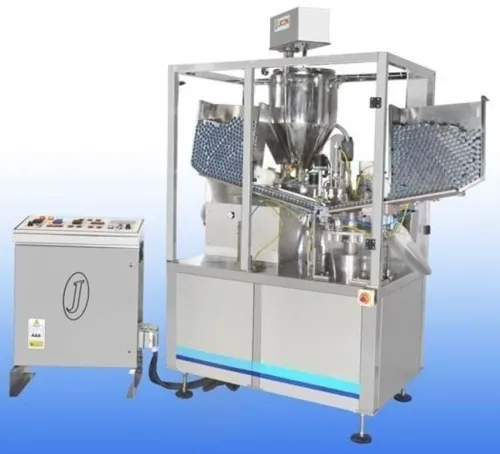
 | Container Filling Machines Automatic Container Filling Machine ₹1 High speed automatic multi head container filling machine for filling cream, paste, ointment, wax polish, grease, jam, sauce etc. View product → |
Frequently asked questions
Which food products can an automatic container filler handle?
Automatic fillers can handle products including milk, yoghurt, cream, mayonnaise, dressings, honey, chutneys, sauces, jam and prepared meals when the dosing system matches the recipe.
Which filling principle matches the recipe?
Use piston filling for viscous products, pump filling for controlled transfer, gravity filling for free-flowing liquids, and auger filling for powders or dry particulates.
What changes when the product is dairy or contains particles?
Dairy filling requires hygienic product-contact parts, cleanability and temperature control. Products with particles need wider product paths, suitable nozzles and gentle transfer.
How do you judge an automatic food filling machine?
Compare target containers per minute, fill-volume accuracy, product viscosity, particle size, changeover time, cleaning method and integration with sealing, labelling and inspection equipment.
What should you check before buying food container filling equipment in Ho Chi Minh City?
Request a product trial using your recipe and containers, confirm food-contact materials, electrical compatibility, operator training, spare parts, cleaning procedures and local technical support.
Related product
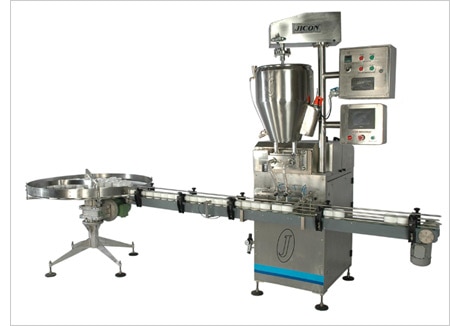 | Container Filling Machines Automatic Container Jar Filling Machine for Ointment and Others High speed automatic multi head container filling machine for filling cream, paste, ointment, wax polish, grease, jam, sauce etc. |