
A quoted tube filler can look complete while leaving the dosing method, manual tasks, change parts, utilities and acceptance tests undefined. By the end, you will have a practical specification and quotation checklist for comparing machines, testing your product and ordering with fewer surprises.
Key takeaways
- Separate operator tasks from machine-cycle output.
- Match piston, peristaltic or auger dosing to your product.
- List tube sizes, seals, codes and change parts in writing.
- Require a product trial with measurable acceptance criteria.
Define What the Operator Does and What the Machine Does
A semi-automatic tube filler leaves tube handling partly with the operator while powering dosing and the selected closing operation. Define every hand action before comparing models; otherwise a quoted output rate can hide the labour needed to load, align and remove each tube.
| Operation | Operator does | Machine does |
|---|---|---|
| Tube loading | Places the empty tube in the holder | — |
| Orientation and cap placement | Aligns the tube and fits the cap when required | Indexes or clamps the tube |
| Filling | Starts the cycle with a foot switch or control | Measures and dispenses the product |
| Sealing and trimming | Sets or monitors the operation | Crimps aluminium, or heats and seals plastic or laminate; trims when configured |
| Coding | Enters settings and positions the batch code | Prints or embosses only if a coder is installed |
| Finished tube removal | Removes and inspects the tube | Releases the clamp |
Ask for these semi automatic tube filler specifications in writing:
- Fill-volume range, stated accuracy, output per hour, and the assumptions for product, tube, operator count and sealing mode.
- Dosing principle, product-contact materials, hopper capacity, tube outside-diameter and length range, shoulder and neck geometry, and compatibility with aluminium, plastic and laminate.
- Machine dimensions, weight, electrical power, compressed-air pressure and ISO 8573-1 air-quality class when air contacts the product or seal.
- Changeover time for your named format, including tube holders, nozzles, sealing jaws, coder settings and required tools.
Match the Dosing System to Your Product and Fill Range
Accuracy starts with the actual dose, not the machine’s headline output. Validate the filling range at your product’s viscosity, temperature and target volume: a unit rated for 5–50 mL of thin liquid may not repeat a 30 mL fill of ointment, cream, paste or particulate food.
Match the dosing principle to the product rather than treating pumps as interchangeable.
| Option | Best fit | Main check |
|---|---|---|
| Piston or servo-piston | Creams, pastes, gels and sauces | Confirm seal design, piston size and cleanability at your dose |
| Peristaltic | Liquids where reduced pump contact matters | Check tubing compatibility, pulse variation and replacement cost |
| Time-pressure | Free-flowing liquids | Verify pressure stability and performance as viscosity changes |
| Auger | Powders and highly particulate products | Confirm particle size, blockage risk and whether the product is sheared |
Specify product-contact materials, such as stainless steel grade, seals and tubing, in the quotation. A tube filler for food products also needs a dosing path that will not trap sauce, fruit pieces or seasoning between batches.
Hopper design determines whether the pump receives a consistent supply. Ask for:
- Jacketed or heated construction when the product thickens as it cools
- Agitation that keeps solids suspended without damaging particles
- A conical outlet and low-level sensor to prevent air entering the dose
- Pump capability for the largest particle, with no bridging, blockage or unwanted shearing
Require a sample run using your product, tubes and target fill. Record fill-weight variation, air pockets and dripping at startup, during steady running and after the hopper level falls; repeatability at one convenient water test is not enough.
Ensure the quoted output states fill volume, tube format, operator count, sealing mode and whether loading and unloading time are included.
Confirm Tube Formats, Sealing, Coding and Change Parts
Do not accept “standard tube size” as a compatibility statement. Ask for the supported outside-diameter range, tube length, shoulder and neck geometry, cap type, and actual compatibility with aluminium, plastic and laminated tubes.
| Material | Closing method to confirm | Format components to confirm |
|---|---|---|
| Aluminium | Crimping pattern, crimp depth, tooling and trim requirements | Tube holder, nozzle position, crimping jaws and cap-handling parts |
| Plastic | Hot-air, ultrasonic or heated-jaw sealing; temperature or energy controls and cooling time | Tube holder, sealing jaws, heated tooling and nozzle for each diameter |
| Laminated | Sealing technology, seal width or pattern and leak-test method | Format plate, tube holder, sealing tooling and coder bracket for the laminate |
A seal that looks correct before cooling can leak during transport. Require a test using your tube and product, with the accepted leak-test method written into the specification.
Coding must be defined before the order: batch number, manufacturing date, expiry date, barcode or serialisation; print technology; printable area; character height; data interface; and whether the printer itself is supplied, mounted and commissioned. “Date coder provision” may mean only a bracket.
Ask the supplier to separate standard tube filling machine inclusions from chargeable change parts:
- Additional dosing nozzles, tube holders, format plates, sealing jaws and coding brackets
- Hopper agitators, cap-handling parts and heated sealing tooling
- Named changeover time, required tools and every manual action: loading, orientation, cap placement, coding alignment and finished-tube removal
Read the Quotation Through Utilities, Hygiene and Service Scope
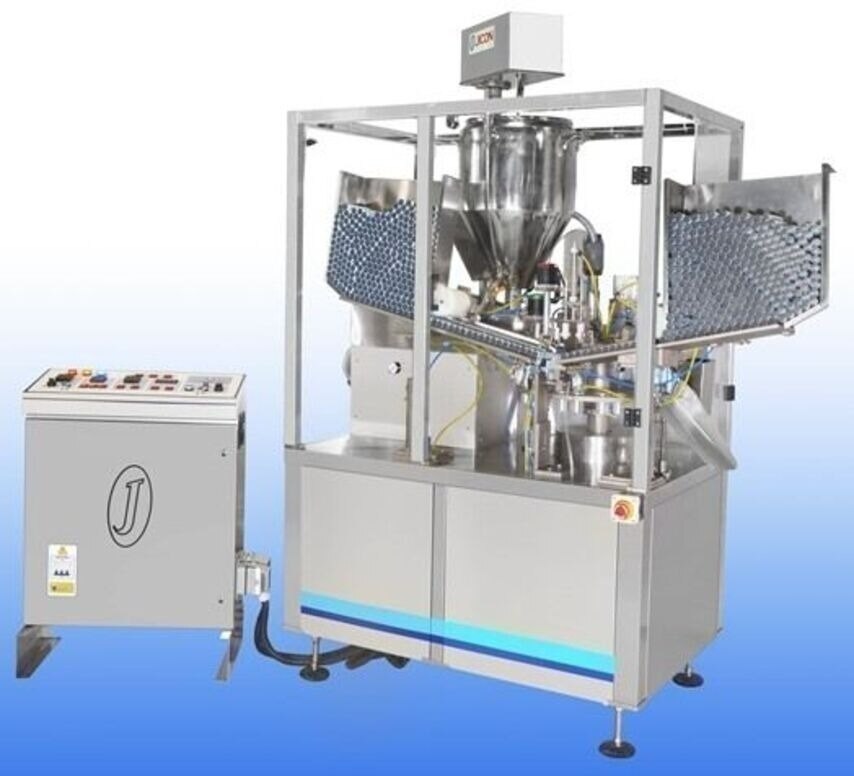
A semi automatic tube filler quotation should identify every item included in the price, not simply state “complete machine.” Request separate lines for the filling pump, hopper, dosing nozzle, tube holder, sealing tooling, controls and foot switch. Confirm whether tube loading, cap placement, orientation, coding, sealing, trimming and finished-tube removal remain manual.
For hygienic review, require the grade and finish of each product-contact part, elastomer type, surface treatment and weld finish. “Stainless steel construction” is insufficient: it does not identify wetted 316L parts, seals compatible with your formulation, or ground and polished welds. Ask the supplier to distinguish contact components from the frame and covers.
The quotation must state electrical voltage, phase, frequency and installed power, plus compressed-air pressure and consumption. Confirm whether the compressor, dryer, regulator, filter and vacuum generator are included, and match the configuration to the electrical supply available in Ho Chi Minh City.
Include these commercial and service items as separate lines:
- Installation, commissioning and operator training, with travel and accommodation responsibility
- Recommended start-up spares, such as seals, hoses, nozzles, fuses and heating elements
- Packing method, crate dimensions, gross weight, insurance and freight to your site
- Standard parts versus charged change parts, including dosing nozzles, holders, format plates, sealing jaws, heated tooling, agitators and coding brackets
Ask for rated output assumptions: fill volume, product, tube format, operator count, sealing mode, and whether loading time is included. Schedule a product trial before approval.
Use a Product Trial and Acceptance Protocol Before Ordering
Run the trial with your actual product, tubes, sealing method and coder settings—not water in a substitute tube. Use this protocol for semi automatic tube filling for machine details before ordering in ho chi minh city, and attach the signed results to the purchase order.
1. Fill an agreed sample of consecutive tubes at the target weight and at the lowest and highest stated volumes. Weigh every tube, record the mean and individual variation, and define the pass limit before testing.
2. Inspect each nozzle withdrawal for dripping, stringing and product on the seal area. Cut open selected tubes to check air pockets, incomplete filling and product trapped above the intended fill level.
3. Seal aluminium, plastic and laminated tubes with their specified tooling. Record temperature or energy, cooling time and seal pattern, then perform the agreed leak test after cooling; a neat seal can still leak during transport.
4. Reject any tube with crushed shoulders, scored walls, distorted ends, split crimps or coding misalignment. Record whether the machine detects and separates rejects.
5. Time a complete changeover between two named formats, including tube holders, nozzle, sealing jaws and coder settings. Count tools and record adjustments.
6. Measure output over a sustained run, stating fill volume, tube format, product, operator count, sealing mode and whether loading and unloading are included.
Ask Jicon Technologies Pvt Ltd to document these results alongside electrical supply, compressed-air conditions and installation acceptance for Ho Chi Minh City. Do not approve delivery until every deviation has an owner and closing date.
Related product
 | Tube Filling Machines Automatic Tube Filling Machine (FT-120, FT-60, ATF-1) ₹1 FILLTUBE Machines are designed to fill and seal plastic, laminated and aluminium tubes at high speeds. View product → |
Frequently asked questions
What does the operator do on a semi-automatic tube filler?
The operator typically loads, aligns and removes tubes, while the machine doses product and performs the selected sealing operation. Confirm every hand action before comparing output rates.
How do you choose a dosing system for a tube filler?
Match the dosing method to product viscosity, solids, fill volume and accuracy requirements. Ask the supplier to demonstrate your actual product across the full fill range.
What should a semi-automatic tube filler quotation include?
Request tube-format limits, sealing method, coding equipment, change parts, utilities, hygiene features, manuals, installation, training, warranty and service scope.
Why perform a product trial before ordering a tube filler?
A trial shows whether the machine handles your product, tube material, fill range and seal consistently. Record speed, fill accuracy, seal quality, rejects and cleaning time in the acceptance protocol.