
The number on a capsule filler does not tell you whether it will produce your herbal blend reliably or reach its saleable output target. You will be able to translate demand into a machine size, match the dosing method to the formulation, compare verified specifications, and define the tests and records required before purchase.
Key takeaways
- Treat ENSULE numbers as model designations until documentation defines their meaning.
- Test the herbal blend with the intended dosing principle before comparing machine capacities.
- Require output, fill-weight variation and changeover data from a witnessed production trial.
- Check capsule formats, spare parts, service response and site requirements before purchase.
What ENSULE 200, 400, 750, 1500 and 2000 Actually Tell You
ENSULE 200, 400, 750, 1500 and 2000 are not universal capacity standards. Each designation might identify a model, output class or another machine specification; only the manufacturer’s documentation can establish its meaning.
| Designation | Do not assume | Confirm |
|---|---|---|
| ENSULE 200 | 200 capsules per minute | Rated capsules per minute, capsule size, dosing configuration and operating conditions |
| ENSULE 400 | 400 capsules per minute | Same four figures |
| ENSULE 750 | 750 capsules per minute | Same four figures |
| ENSULE 1500 | 1,500 capsules per minute | Same four figures |
| ENSULE 2000 | 2,000 capsules per minute | Same four figures |
Calculate a saleable-output target as demand divided by available production hours, then adjust for uptime and reject rate. Available hours must subtract changeovers, cleaning, line clearance and powder replenishment. Include shifts per day, planned growth and seasonal demand in the calculation.
Theoretical speed is not net good capsules. A machine running at its rated rate can deliver less saleable product after stoppages, weight-control adjustments and rejected capsules.
A 750-class machine can be the wrong choice if the herbal blend bridges in the hopper, requires frequent operator intervention or needs long format changes. Its apparent speed then consumes more labour and schedule time than a slower, more stable machine.
Ask for rated output at your selected capsule size, minimum and maximum fill mass, acceptable reject rate and the test conditions behind every figure. That is the basis for comparing automatic capsule filling machine sizes.
Match the Herbal Blend to the Dosing Principle Before Choosing Capacity
Consistency depends on the blend, not the machine’s nominal speed. Measure bulk and tapped or compacted density, particle-size distribution, angle of repose, moisture and flow rate on representative lots. Fines, electrostatic adhesion, oils, hygroscopic ingredients, long fibres and segregation can cause bridging, rat-holing, dosing-disc failure and weight variation.
Approximate geometric capsule volumes are:
| Size | 000 | 00 | 0 | 1 | 2 | 3 | 4 | 5 |
|---|---|---|---|---|---|---|---|---|
| Volume (mL) | 1.37 | 0.95 | 0.68 | 0.50 | 0.37 | 0.30 | 0.21 | 0.13 |
These are volumes, not dose limits. Capsule volume multiplied by the usable-volume fraction and compacted density estimates fill mass; it does not guarantee the result.
- Free-flowing powder: trial a dosator, tamping-pin or auger system.
- Cohesive powder: consider slug formation or intermittent dosing.
- Pellets: verify controlled feeding without crushing.
- Mini-tablets: confirm pocket, feed and ejection compatibility.
Low-density powder may need a larger shell, excipient, higher compaction, granulation, slugging or a split dose. Excessive tamping can worsen plug ejection and slow dissolution.
Tamping pins can improve repeatability but increase compaction; dosators suit defined plugs; augers control cohesive feeds but can increase powder loss; intermittent systems can reduce loss yet expose restart variation. Compare weight repeatability and recovery using the finished blend.
Require restart, low-hopper, replenishment and extended-run trials for any ensule capsule filler for herbal products. Record segregation, rejects and powder loss at each condition.
Build a Specification Table That Separates Proven Data from Sales Claims
Compare the five ENSULE designations using verified net performance, not the model number alone. Use “SVR” only where the supplier must provide evidence; it means supplier verification required.
| Model | Verified capsules/min | Verified capsules/hour | Tested capsule-size range | Dosing-system options | Fill-weight accuracy and sampling basis | Hopper capacity | Footprint | Electrical supply | Compressed-air demand | Cleaning time | Changeover time | Format-part requirements |
|---|---|---|---|---|---|---|---|---|---|---|---|---|
| ENSULE 200 | SVR | SVR | SVR | SVR | SVR | SVR | SVR | SVR | SVR | SVR | SVR | SVR |
| ENSULE 400 | SVR | SVR | SVR | SVR | SVR | SVR | SVR | SVR | SVR | SVR | SVR | SVR |
| ENSULE 750 | SVR | SVR | SVR | SVR | SVR | SVR | SVR | SVR | SVR | SVR | SVR | SVR |
| ENSULE 1500 | SVR | SVR | SVR | SVR | SVR | SVR | SVR | SVR | SVR | SVR | SVR | SVR |
| ENSULE 2000 | SVR | SVR | SVR | SVR | SVR | SVR | SVR | SVR | SVR | SVR | SVR | SVR |
Ask whether each output figure used your finished herbal blend, shell size, fill mass and dosing principle. Require net output after rejects, cleaning, powder replenishment, weight adjustments and unplanned stops—not strokes per minute.
Request a complete format-part list covering capsule guides, feeding components, dosing parts, closing parts, dosing discs or tamping arrangements. The capsule filling machine manufacturer should document factory acceptance testing for fill-weight variation, powder recovery, restart performance, reject rate and the formulation’s operating window, including bulk-density limits and hopper level.
Jicon Technologies Pvt Ltd should identify which figures are measured data and which are design claims before quotation.
Related products
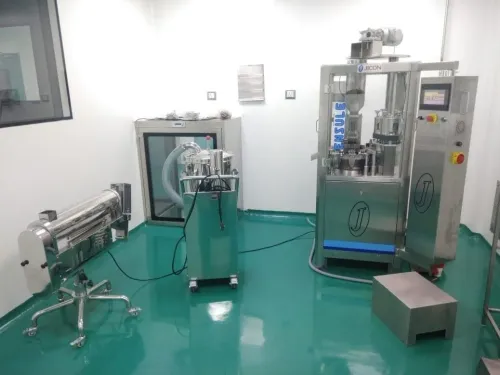
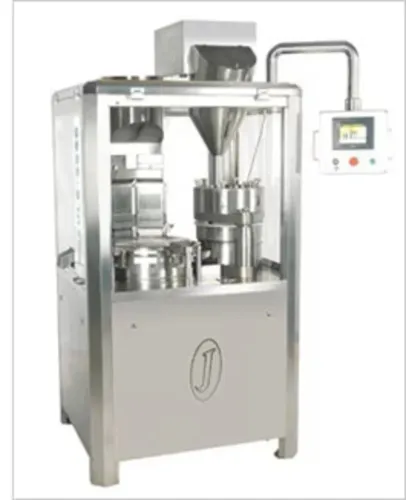
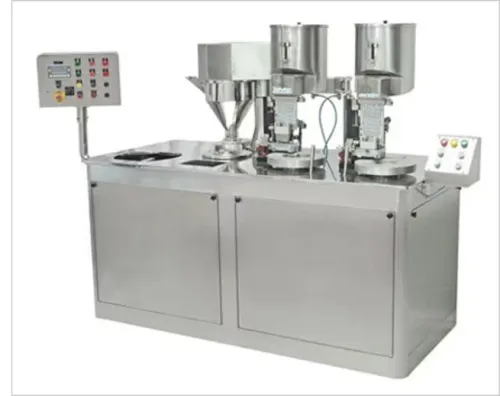
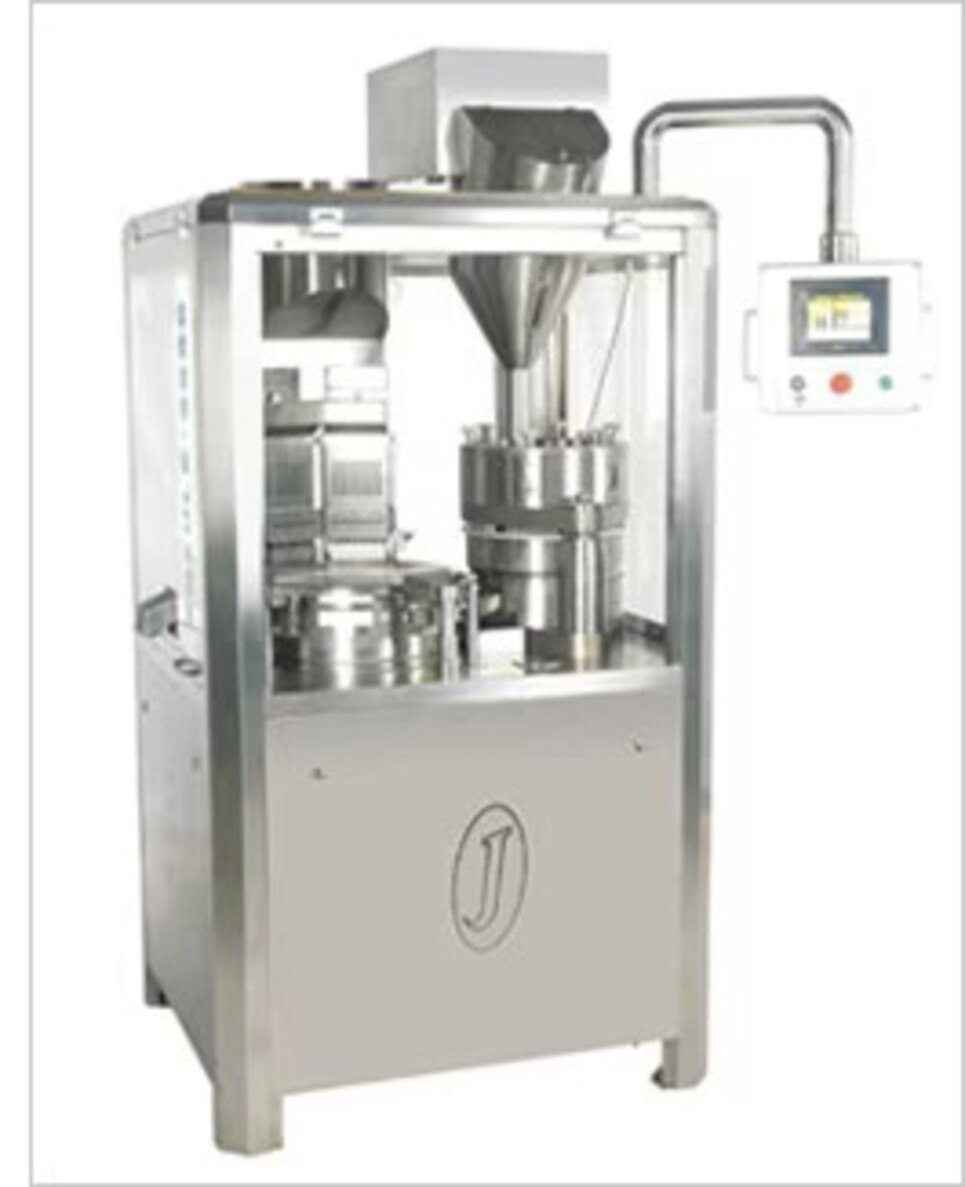
 | Capsule Filling Machines Automatic Capsule Filling Machines ENSULE Our ENSULE series of machines are Fully Automatic Capsule Filling machines used to fill powders (in the form of slugs, pellets or mini tablets) in... View product → |
 | Capsule Filling Machines Automatic Capsule Filling Machine ENSULE 2000 ENSULE 1500 ENSULE 750 ENSULE 400 ENSULE 200 Our ENSULE series of machines are Fully Automatic Capsule Filling machines used to fill powders (in the form of slugs, pellets or mini tablets) in... |
Choose the Capsule Shell, Format Parts and Operating Sequence Together
Size choice starts with the finished blend, not the broad range in an automatic capsule filling machine sizes brochure. Geometric volume provides space, not dose: herbal fill weight changes with bulk density, tapped density, fibre, oil, moisture and compaction.
| Size | Approx. geometric volume | Trade-off |
|---|---|---|
| 000 | 1.37 mL | Highest capacity; harder swallowing and more material per capsule |
| 00 | 0.95 mL | Common compromise between dose and usability |
| 0 | 0.68 mL | Moderate dose; often easier to handle |
| 1 | 0.50 mL | Smaller dose and lower material use |
| 2 | 0.37 mL | Useful for compacted blends |
| 3 | 0.30 mL | Small dose; tighter dosing tolerance |
| 4 | 0.21 mL | Low dose; sensitive to fibres and poor flow |
| 5 | 0.13 mL | Smallest shell; limited space and demanding filling |
Hard gelatin shells need controlled humidity because dryness causes brittleness and cracking; excess humidity softens shells. HPMC shells resist brittleness better at lower humidity and suit some hygroscopic blends, but static, storage conditions and machine separation still require trials. Test both materials against oily, acidic and moisture-attracting herbs.
During demonstration, watch shell loading, orientation and separation; dosing; tamping or slug formation; body-cap closing and lock inspection; ejection; dedusting; metal detection; collection; and reject segregation. Ask whether the system handles coarse fibres and cohesive fines.
Ask for every changed format part, line-clearance and changeover time, identification labels, storage method and price. A broad shell range can hide hours of operator time and lost production; compare that cost with the claimed output.
Set Acceptance Tests and Riyadh-Specific Supplier Checks Before Purchase
Commercial suitability requires witnessed evidence on your finished herbal blend, not a catalogue speed. Agree factory-acceptance criteria with quality before purchase, then test the selected shell, dosing principle, fill mass, density range and operating window.
1. Sample 30 capsules at startup, mid-run and end-run. Record every capsule weight, calculate mean and variation, and stop for investigation if any result exceeds the pre-agreed specification or the machine’s agreed response limit. Apply USP <905> Uniformity of Dosage Units where applicable; do not copy limits from another jurisdiction.
2. Test blend uniformity at defined hopper locations and production stages, then test disintegration, moisture, foreign particles, metal-detection challenge pieces, powder loss and reject percentage. Record capsule-lock inspection results, line clearance, adjustments, stoppages, reconciliation and deviations in the batch record.
3. Require the quality team to verify the current Saudi regulatory rulebook and product classification. Use 21 CFR Part 111 only when the product is subject to United States dietary-supplement requirements.
For Riyadh, obtain documented electrical load, voltage, frequency and compressed-air pressure, flow, filtration and dew-point requirements. Confirm sanitation and line-clearance procedures, operator training, calibration support, spare-parts lead times, service response and local installation capability.
Treat automatic capsule filling machine manufacturer for herbal production in Riyadh as a supplier-search description. Treat ensule capsule filler for herbal products as a search term, not a technical standard.
Ask the capsule filling machine manufacturer to identify the actual model, dosing principle and tested formulation, then have both parties sign independently agreed acceptance criteria before testing.
Frequently asked questions
What do ENSULE 200, 400, 750, 1500 and 2000 indicate?
They are not universal capsule-filler capacity standards. Ask the manufacturer whether each number identifies a model, output class or another specification, then verify the definition in the technical datasheet and quotation.
How should you match a herbal blend to a capsule filling machine?
Test the blend’s flow, bulk density, moisture and particle size with the proposed dosing principle. Compare trial fill-weight results rather than selecting a machine from its nominal speed alone.
What data belongs in a capsule filling machine specification table?
Record confirmed output at a stated capsule size, fill-weight range, weight variation, dosing method, capsule formats, changeover time, machine dimensions, utilities, cleaning method, spare parts and service commitments. Label each item as tested, documented or claimed.
What should you check with a Riyadh capsule filling machine manufacturer before purchase?
Request a witnessed trial using your herbal blend, confirm local installation and service arrangements, verify electrical and compressed-air requirements, identify replacement format parts, and define acceptance tests in the purchase contract.
Related product
 | Capsule Filling Machines ENSULE: Automatic Capsule Filling Machines Our ENSULE series of machines are Fully Automatic Capsule Filling machines used to fill powders (in the form of slugs, pellets or mini tablets) in... View product → |